Author: lormace

  • On Being Related

    “Without relationship, there is no existence: to be is to be related. Most of us do not seem to realize this;that the world is my relationship with others, whether one or many. My problem is that of relationship. What I am, that I project, and obviously, if I do not understand myself, the whole of relationship is one of confusion in ever-widening circles. So, relationship becomes of extraordinary importance, not with the so-called mass, the crowd, but in the world of my family and friends, however small that may be, my relationship with my wife, my children, my neighbor. In a world of vast organizations, vast mobilizations of people, mass movements, we are afraid to act on a small scale; we are afraid to be little people clearing up our own patch. We say to ourselves, “What can I personally do? I must join a mass movement in order to reform.” On the contrary, real revolution takes place not through mass movements but through the inward revaluation of relationship; that alone is real reformation, a radical, continuous revolution. We are afraid to begin on a small scale. Because the problem is so vast, we think we must meet it with large numbers of people, with a great organization, with mass movements. Surely, we must begin to tackle the problem on a small scale, and the small scale is the “me” and the “you.” When I understand myself, I understand you, and out of that understanding comes love. Love is the missing factor; there is a lack of affection, of warmth in relationship; and because we lack that love, that tenderness, that generosity, that mercy in relationship, we escape into mass action which produces further confusion, further misery. We fill our hearts with blueprints for world reform and do not look to that one resolving factor which is love.”

    J. Krishnamurti, The Book of Life

    This reminds me of a D’ne reprimand. When a child misbehaves, when someone commits a hurtful act, they say, “You act as though you have no relations.”

  • A Possibility

    “Is it possible to be related without idea, without demand, without ownership, possession? Can we commune with each other – which is real relationship on all the different levels of consciousness – if we are related to each other through a desire, a physical or psychological need? And can there be relationship without these conditioning causes arising from want? As I said, this is quite a difficult problem. One has to go very deeply and very quietly into it. It is not a question of accepting or rejecting.”

    Jiddu Krishnamurti

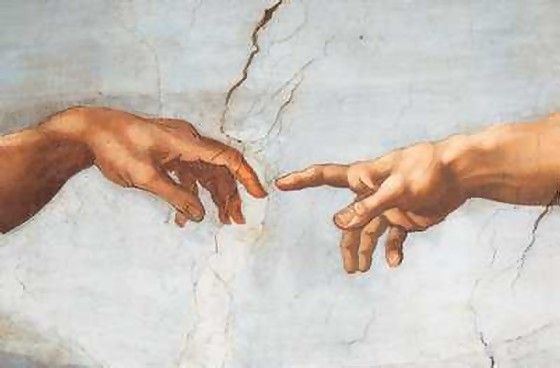
    hand of God

  • Recommendation: “The Unruled World”

    One must wonder if it is a good thing that, “Instead of constraining our power, [international organizations] magnified it.”” -Barack Obama

    http://www.foreignaffairs.com/articles/140343/stewart-patrick/the-unruled-world

  • Martes, 9 de Julio, 2014

    I have purchased, for €6, a copy of Washington Irving’s Tales of the Alhambra, and I am finding it a delightful companion, one that shares my whimsy and romanticism.

    Of Andalusia, he says:
    “For the greater part it is a stern, melancholy country, with rugged mountains and long sweeping plains, destitute of trees, and indescribably silent and lonesome, partaking of the silent and solitary character of Africa.”
    Well, I can say that this is true, although I would compare it first with my homeland, of which old Irving would probably share the same opinion. However, we lack-

    Olives.
    There are around 300 million olive trees in Spain, and we just visited the home of about five thousand of them at the Basilippo plantation outside of Sevilla.

    I noticed olive trees as soon as we landed in Madrid. They hold the place taken by junipers in the Rockies, marching over the foothills of the mountains and down into the valleys in gentle ranks.

    Many of these olive trees are centuries old. One fellow at the plantation was six hundred and fifty! He stood before the kitchen door before the discovery of the New World, before the Reconquista, while Spain was still ruled by the Moors and Europeans were bumbling around up north. Apparently the oldest tree in Spain is fifteen-hundred yeas old, and grows near the French border.

    Our very Mediterranean guide showed us his rows of unassuming trees, pointing out the hard little midsummer olives. “We say we are talking to de trees for nine months, becoze is a relationship- da tree is da factory dat produce da extra firgin oliff oil, and we are just extract.” (I liked this very much)

    He then described the old practice of hitting the trees with sticks to harvest the olives in a net, but now, “If we been talkin’ to da tree for nine months, you think then we gonna fight da tree? No! We shake.” And he demonstrated by shaking the branches enthusiastically.

    Later, he took us into a low, spacious room with diagrams of fats, all declaiming the superiority of “oliff oil,” and showed us tiny models of historical presses.

    These were wonderful. The first was the Molina that was used from ancient times all the way to the eighteenth century. This assembly of mats and heavy stones was an ingenious use of solar energy from the donkey’s breakfast of field grass. A later model from the industrial revolution ran on a water wheel (and how valuable are water rights in all times-both bread and oil mills ran on hydropower).

    Well, energy of sun and stream have now been replaced with a power grid connected to assorted sources of power. We saw both solar and wind farms on our way through Andalusia. Today’s electric mills use a centrifuge to separate the oil, water and solids that compose the olives, so the product is pure enough to allow fine flavors to emerge from the green oil like timid fairies. The Roman Emperors never tasted anything close.

    It always amazes me to remember that even a poor person in an industrialized nation lives better than an ancient emperor. Not only is our olive oil free of stone dust and donkey hairs, our cheapest wines would have had the Caesars singing. Even a royal handmaiden would never have had a room of her own, while toddlers are given their own bedrooms today. Sanitation was unknown, privacy was a joke, and olive oil with flavors of grass, tomato and “a hint of banana on the nose” was unheard of. Whatever we mean when we say “the good old days,” we aren’t talking about anything, you know, real.

    For more on the historical hardships of everyday life, please read Bill Bryson’s magnificent At Home: a short history of private life.

  • Lunes, 8 de Julio, 2014

    Ayer fuimos al Alhambra…

    The approach to the city, or fortress, or palace (depending on who approaches) is up a hill wooded with mighty chesnuts, those trees that make my heart weep, for ours in America were lost. Little culverts and streams tumble down from the high Sierra Nevadas in the background, filter through the fountains and Acequias of the Alhambra, and descend into el prado de Granada.

    Then, as you climb, the fortress walls emerge, a little crumbly but still imposing, with grace in their lines but no ornamentation. The Sunnah (the lesser known and more, er, procedural of Islamic texts) implores it’s followers not to awaken the jealousy of their neighbors, and so Moorish edifices have simple exteriors. I need hardly mention that this differs from the elaborate crusts of antique European buildings, but more on that later.

    We passed the studded main gate and entered through a smaller door meant for tour groups. After a courtyard with a fountain and citrus trees, we entered the Nasrid throne room, where the Sultan received important visitors. I remember picking lemon thyme in the courtyard and rolling it between my fingers, for the whole place made me wish that the incenses and oils of the Moors still scented the rooms.

    Here, the Caliph held court with his scribes and ministers, who had little enclaves for offices around the hall. They would have perched on piles of carpets and cushions, dipping their pens to scribble lacily scripted orders. This is also the place where the last sultan surrendered Granada in 1492 after a long siege by the forces of Ferdinand and Isabella. They say that after his surrender, the sultan left the generalife for Africa, and never returned to his paradise.

    Ferdinand and Isabella proceeded to make the throne room their own, the first for a unified Spain. In this room, they bid Columbus farewell on his search for The Orient. From this throne room, the ripples of Spanish history spread.

    “The Catholic Monarchs” also made the first Christian additions to the complex, but it was Carlos V who really expanded the place.

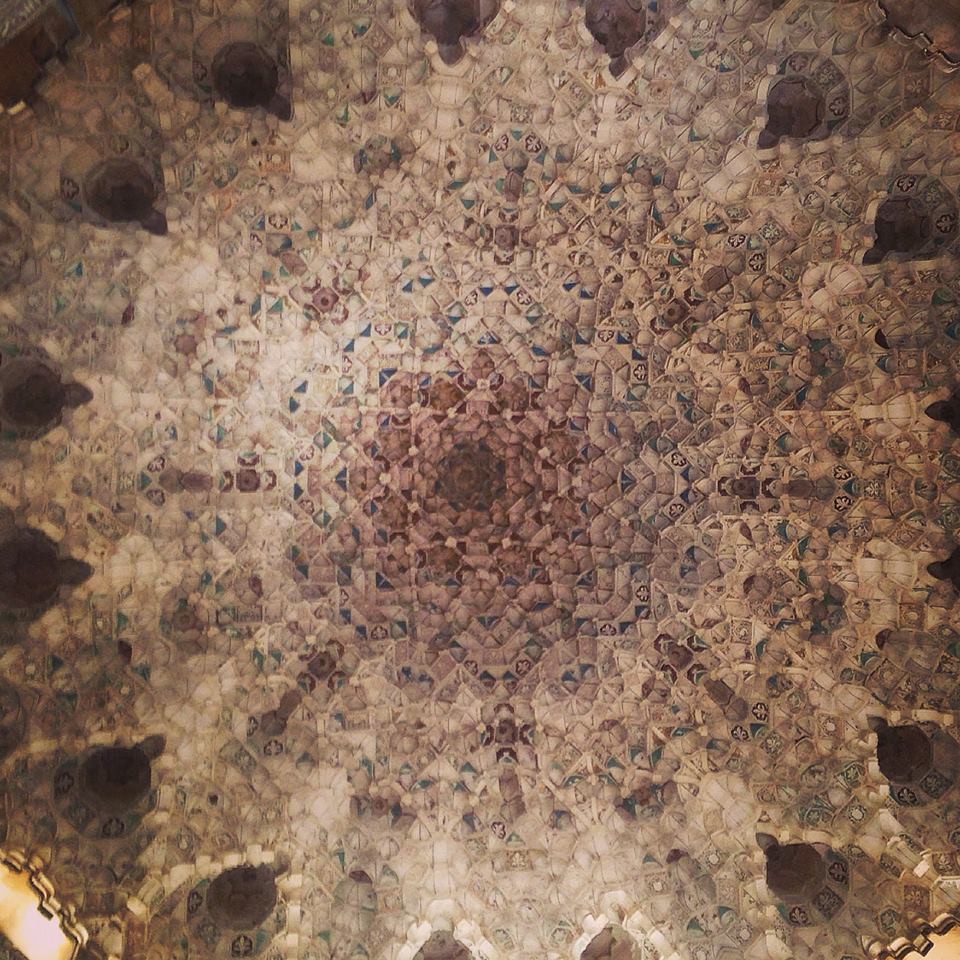
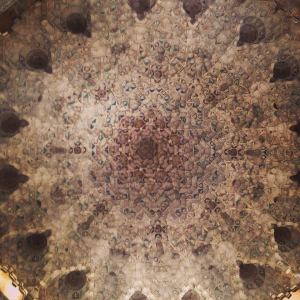
    I must mention here that the juxtaposition of the two architectural styles is jarring. The Moorish designers played with geometric principles in letters, lines and sinuous plant motifs to create an organic look from strict mathematical measures. Their art is a testament to the order that informs all things: the universe is not created from simplistic or chaotic impulses; hidden rule and subtle principle pervade nature.

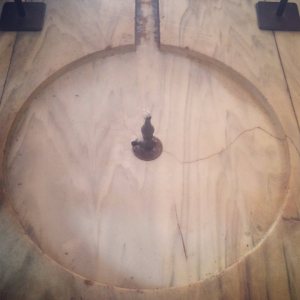
    I must let all the photographs and drawings of the Alhambra speak rather than the thousands of words it would take me to describe its intricacy and elegance. In its time, each room used all four elements in harmony- flowing water, dancing earthen plaster, flickering oil lamps and windows open to the breeze.

    We walked through the Court of Myrtles, with its reflective pool and moldings of Lebanese Cedar, into the family chambers. The spacious apartment of the sultan’s four wives was my favorite. Two of them were sisters. In their chambers, I could feel the lingering memories of playing music, dancing for their family, laughter over steaming tea. They might have been very happy in their sumptuous cage. The tinkling fountain of snowmelt still bubbles in their home, centuries after the laughter of their children ceased.

    Yes, the contrast. From the harem, one exits into the steam rooms, then into a low hall built by Isabella and Ferdinand. The criss-crossed roof beams seem simple and careless after the ethereal alcazar. Ferdinand only had the creativity to engrave Plus ultra on each, proclaiming that his kingdom stretched to the New World. This differed somewhat from the Sultan’s motto: Wa la ghalib illa Allah, “No winner but Allah,” repeated nine thousand times on his walls.

    Really, I thought the whole European section seemed to declare proudly, “We’ve discovered the square!”

    If their works were primitive in comparison, at least the Europeans did not destroy the Alhambra out of barbaric confusion or resentment.
    10531127_926644176211_516922868_n


    10529477_926644231101_1755284591_n

  • Domingo, 6 de Julio, 2014

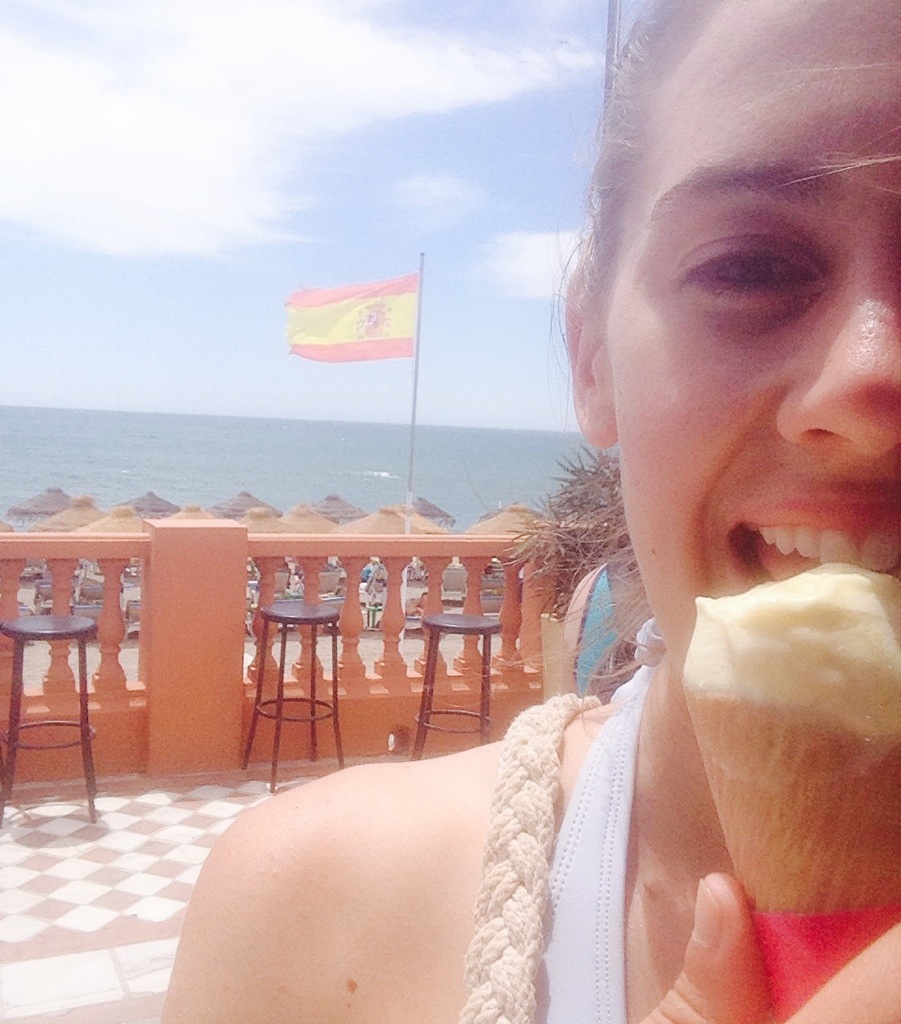
    The Mediterranean- I have just stepped into her waters for the first time. I think of corsairs and kings, the ships mouldering in her deeps and the empires built on her shoulders. A stiff westerly wind hauls the waves today, bearing grains of sand with whispered names: Gibraltar, Carthage, Morocco. From the East, an imagined echo: Byzantium, Istanbul, Troy, gone, gone gone…
    It’s shoulders are now freckled, this particular afternoon in Southern Spain, with fit, fair people of many nationalities. There are bare-breasted Spanish and German women, and my awkward American teenagers, wiry men in speedos. Atop the sedimentary layers left by fervent tradesmen and conquerors (the Phoenicians, the Carthaginians, the Romans, the Moors), dwell a calm, minimalist population who don’t fuss much, and today I feel the same.
    The west wind seizes an old man’s floating lounger and he bursts into a wild front stroke that defies his balding paunchiness. The Med here is cold, the soldier and the Saracen who have washed, splashed, dreamed and drowned in her salty waters never mentioned that. But she’s big water. Not all of her can be warm as a Roman bath.
    I’ve got to sign off to entertain the jet-lagged, culture-shocked and, now, windblown teenagers. I can be such an introvert when traveling, I just want to take it all in, silently, alone with this page and the sea.

    Hasta Luego,

    Laura

    20140709-074221-27741215.jpg

    20140709-074222-27742765.jpg

    20140709-074223-27743582.jpg

  • “We have a say in the kind of world we are going to inherit.”

    Some friends from Boulder are featured in this article from Al Jazeera, describing an interesting approach to mitigating climate change: since the executive and legislative branches of government are financially intimate with the fossil fuel industry, these kids have taken the issue to the courts. 

    http://america.aljazeera.com/articles/2014/5/4/youth-sue-governmentforclimateinaction.html


  • Learn about net neutrality.

    Net neutrality has made the internet what it is- equal speeds and access for any publisher of information. New FCC regulations will change this (WITHOUT any need for legislative approval) at the end of May, unless there is enough public outcry. These new regulations would allow broadband providers to sell the rights for larger corporations to deliver their content much faster at the expense of everyone else. And on a thing like the internet, attention follows speed. The internet should be protected as a Commons. Read more about this here:

    http://www.fool.com/investing/general/2014/05/05/business-take-fccs-net-neutrality-rules-good-for-i.aspx

    The nonprofit Mozilla has offered some legal solutions to the net neutrality conflict:

    http://recode.net/2014/05/05/mozilla-offers-idea-for-solving-net-neutrality-problem/


    davies

  • Run-on sentences from when I moved back to Taos…

    I mentioned it before: Tolstoy said “All great literature is one of two stories; a man goes on a journey or a stranger comes to town.” Which is actually one story from two perspectives.
    Well.
    I plunked my college things at my parent’s house. They have lots of storage sheds, the stuccoed kind out back that match the house colors but not quite- I put the rubbermades with the broken handles and the stacks of books with dog-eared corners and notes in the margins like this professor desperately needs to get laid and the third-rate cooking implements and my fishnet stockings (which I would regret leaving), yes I put all of these things away in stack that I hoped was neat enough to trigger nostalgia in my father rather than annoyance at the space it took up.
    I had my application from Americorps, that strange bit of the government that deals with unskilled college kids who can’t bear the thought of going straight into anything familiar. My Taurus was crowded and the front seat was still a bit of a mess from a goodbye trip to my sister’s place. I subsist on popcorn and grapefruit juice when I travel, and the detritus usually accumulates, sedimentarily, in my front console.
    So I perched the application and my purse with proper identification and all the other things that need to be within reach on top of the teetering pile of jackets and pillows and a jewelry box and ten years worth of journals that I just couldn’t leave behind.
    I kissed Dad goodbye, he was being loving and pouty and wondering aloud, as he always does, “Why can’t you just stay here? Why do you have to go charging off somewhere? The schools here are hiring and they pay much better,” etc.
    And I gave my customary poetic answers- “Dad, ‘Two roads diverged in a yellow wood, and I, I took the one less travelled by, and that has kept me from dying of heart disease.” Things along those lines. “To live, perchance, to dream, of being somewhere without a mall,” and so on. We did it all morning and it became rather wearisome.
    We were going to miss one another very much. Our final hug was quite a lingering, squeezing thing and I noticed that he was a little squishier than he was at the beginning of the summer. “Lay off the scotch eggs, Daddy.” I said. I’ll miss you more than words can say.
    “You probably won’t even get enough to eat,” I’m proud of you- you have come so far, this is all going to be worth it.
    “There will be plenty to eat! I’m a grownup, for heaven’s sake.” Thanks, Daddy. I’ll come home way more often then is convenient or reasonable.
    “Okay. I love you, honey.”
    “I love you, Pops.”
    I ducked into the car and fiddled with my iPod, then jerked into OD and pulled out of the driveway. He watched me go on pretense of checking the mail that wouldn’t come for hours.

    Gas station Earl Grey is unacceptable. Typically the water is either too hot, in which case it scalds you for the first twenty minutes that you try to drink it, or it is too cold, and then the teabag just leaks listlessly like a white lie. Invariably, the tea takes on the flavor of the cup, which hopefully is not styrofoam, but even when it is paper, there is some kind of residue from its manufacture that is activated by scalding or lukewarm water. Honey and RBGH milk do little to ameliorate this situation.
    I stepped out of the only gas station in Fort Garland into the most arresting scenery- mountain peaks like a crown on the northern horizon, their steeps blazing in the sun. Their blue roots gave way to monsoon-green fields, only interrupted by the highway and this gas station, black holstein cows plodding about just on the other side of the fence.
    Gas stations are, for me, a symbol of dissatisfaction. Where is it written that their wares have to be too sugary or too salty to be advisably consumable? Why are primary colors and linoleum the decor of choice? Has no one ever thought, gee, I think I’ll make a nice cozy gas station, perhaps in the log-cabin style. I’ll get some fruit, some nuts, some good hard cheeses and sparking water, brew some strong, fair trade coffee and offer real cream, keep the bathroom really clean with some potpourri in a bowl on the toilet and a painting of a ginger kitten in a basket of flowers for you to gaze at as you try to induce your travel-compressed intestines to eliminate? Oh, and most importantly, I’ll filter the tea water and keep it at a sensible temperature, and buy cups that won’t dissolve into carcinogens when filled with it. And tea sachets, please.
    I mean, who wouldn’t be willing to pay more?
    But then I get into the gas station and I see 25 people buying cheetos puffs with heavy-lidded eyes, and 40 oz. Rip Tide Mountain Dews, with wispy bits of low quality toilet paper stuck to the bottom of their New Balance tennis shoes and… well, I realize that it is not that entrepreneurs have never had this thought, but that Americans are culturally conditioned to salivate at the sight of primary colors and the smell of packaging.
    I got back in the car with a sigh. The drive was long, the scenery was all that was keeping me from dashing my abysmal Earl Grey into my face to keep myself awake.

    Steinbeck said, “I believe that there is one story in the world, and only one.”

  • 1.27.2014 – Houston Smith

    Religion is more than morality, but if it lacks a moral base, it will not stand. Selfish acts coagulate the finite self instead of dissolving it, ill-will perturbs the flow of consciousness.

    Houston Smith, The World’s Religions