Generous light, abundant water. The days warm swiftly, but when I bend to touch the river, it is icy cold. Water has a long memory — on the longest day, it remembers the chill of the dark.
Last December, I wrote about steam rising from the Arkansas on the shortest day of the year, still holding the warmth of summer sun. When I wade gratefully in now, I feel the crystalline winter in the high country.If you celebrate the pulsation of opposites, the cool of the water on the longest day of the year is a festival for the senses.
The world is in full bloom from drinking in sun and rain. Lavender is ready for harvest in my garden and wild roses are dropping petals on the north bank of the river. Both are cooling, balancing plants for this time of year.
Our bodies also bloom in this season, invigorated by spring and not yet faded from long heat. It is a good time for pushing your physical practice, whatever that may mean for you. Heat makes us more flexible, abundant daylight makes us more energetic. Big, heart-opening poses may be more available than other times of year, so I invite you to practice up to poses like ustrasana (camel), setu bandha sarvangasana (bridge), or even urdhva dhanurasana (wheel). Working up to these poses can help you feel what it is like to truly bloom toward the summer sun.
Join me at our Yoga on the River class on Saturday, June 21st to experience some of these poses for yourself.
Category: Musings
-
Yoga of the Season: Summer Solstice 2025
-
Yoga of the Season: Vernal Equinox 2025
The first poem I ever got published graces the Vernal Equinox pages of an astrology datebook. Dropping it here in honor of the equal day and night- and by the way, I consider this to be New Year’s Day!
Hope
Dear Belated Friend,
Have hope.
Seeds are made with all ways of being tucked inside.
Clinging, pricking, wafting, sinking, reaching, bursting, luring, floating, rolling,
breaking
they start by breaking. It is their end and their beginning
Remember, “the wound is where the light enters”
Count the days
Count the nights,
Orion slips behind a cloak of day. Men come out and women sigh and Venus takes coins from her purse to relieve the poverty of winter, the long winter, the Fimbulvetr
that took your finger?
the ground gasps and gushes
Venus smiles her trap smile.
She knuckles her way forward, spring, Ostara, lips wrap around seeds and sleep is no master, slurp the curves of a brimming world.
Let her lure you back with the tang of dandelion and young mint.
“Hope” (c) Laura C. Mace, 2022
-
Yoga of the Season: Autumnal Equinox 2024
Hello Friends!
This is my first update since returning from maternity leave, and my little Sierra Grace is already eight months old! I finally feel that I can take on something beyond gardening and mothering… if those can be considered separate tasks.
Sun-bleached skipping stones lie exposed on the banks of the ebbing Arkansas River. I still bask in the abundance of late summer, but with a sigh of relief after the searing heat. The light has sharpened and shadows are lengthening. Our garden is heavy with tomatoes, the alleyways of our neighborhood littered with peaches and apples, and on our weekly pilgrimages to the mountains, I chase my boy through green woods, but wrap the baby against the chill. We scan the aspens for the promised gold.
Harvest time, harvest time. Across the northern hemisphere, a time to focus on reaping what has burgeoned in summer’s warmth. Gather. In the yogic tradition from far, far away on the Indian Subcontinent, this is known as Sarasvati’s time- hail to the goddess of clean wit and high knowledge! Her bright vision illuminates the world’s corners and contrasts, picks the clean fruit from the rotten. She is a source of strong, steady energy, giving us the endurance and wisdom to bring in the best of the harvest.
In this season, I find I can work hard and rest well. Early autumn is a time of balance between light and dark, warmth and chill. The practices I offer at this time honor this by combining steady effort with grateful surrender.
Upcoming opportunities to practice:
Yoga on the River ~ Saturday, September 7th, 10am-11am
Every 1st Saturday at the River Campus of the Nature and Wildlife Discovery Center. More info here: https://hikeandlearn.org/…/september-yoga-on-the-river/
Women’s Wellness Weekend at Camp Jackson ~ September 27-29th
I am delighted to be the yoga and meditation instructor for this mountain retreat- fingers crossed, it should be great timing for the aspens!
Revitalize and Reconnect in the San Isabel Mountains! Join us for a rejuvenating escape at YMCA Camp Jackson from September 27-29, 2024. Set against the serene backdrop of the San Isabel Mountains, our Women’s Wellness Weekend offers a perfect blend of tranquility and adventure designed to refresh your body, mind, and spirit. Lodging, meals, and activities included.
Community Cabin: $150 per person
Private Cabin $200 per person
Registration ends September 26th, sign up today at puebloymca.org/events
Activities Include:
- Yoga & Meditation
- Self-Defense Classes
- Exercise Classes
- Crafts
- Hiking
- Ropes Course & Zip Line
- Rock Climbing
- Canoeing
- Massages
Women’s Wellness Weekend is your opportunity to take a step back from daily routines and immerse yourself in a supportive community. Whether you’re looking to relax, learn new skills, or simply enjoy the beauty of nature, our custom adventures and peaceful activities are designed to help you reset and restore.
Gentle Yoga — Weekly at 10 AM on Fridays
I am resuming my classes at the YMCA of Pueblo! Offering low and slow yoga at 10 AM on Fridays.
Blessings, and hope to practice with you soon!
Laura
-
The Yoga of Relationships, II
In the yogic tradition I trained in, the ground is the first point of focus. Upon entering a pose, we draw our attention to points of contact with the earth, sensing energy move from the ground into our body, turning the spirals of energy that then fuel the full expression of the asana.
Where is the ground in an abstract, perhaps difficult, conversation about values, choices, strategies that challenge us? Where it is in a yoga pose – beneath my feet, and pulsing in my breath.
Whether we call it God, the Earth, our Higher Self, or just our “center” or “breath,” we all exist by connection to what is more than ourselves. In the most atheistic of terms, Consciousness, what we call our selves, cannot exist without breath for more than a few moments – we are fundamentally dependent on an external source of life. In feeling this connection to our source of life, we reground. We touch back to the fundamental, and our tensions and cares can be reabsorbed into this source.
Disconnection from my partner arises when at least one of us feels disconnected from this source of life. Connecting to this force helps us reconnect to ourselves so that we can then reconnect with one another.
All that sounds very complicated, but reconnecting to your center can be very simple: when you are about to enter into a conversation that may be full of conflict, breathe consciously. Just twelve thoughtful breaths can change your physiological response to conflict. Release your jaw and shoulders as you breathe. This will help deactivate your stress response and prime you to connect to the world, and people, around you.
-
Yoga of Relationships, I
After a somewhat difficult morning with our six month old baby who disagreed with us about the level of daylight that should accumulate before starting our day, my husband and I had a rough conversation or two before he left for work at my dad’s business, where he is a senior engineer.
I felt very in the right in the somewhat tense conversation… until he left, when I looked around and saw all the blessings of our life together, remembered that he let me sleep in this morning, saw that he did not get to make himself coffee. I felt a wash of gratitude for what this relationship has given rise to. And I felt sheepish, not because the things I said were unimportant or inaccurate (they were both), but because they were not spoken from a place of alignment and attunement. I felt sort of the way I do when I attempt a difficult yoga pose without any warm up, aligning and breathing my way gradually into it. I realized suddenly that this is how I go into many important conversations – as though they were a leisurely walk. In fact, we are discussing parenting and working for a family business– these are not walk in the park conversations. Discussing our fallibility, our challenges as parents, our bad habits, our interactions with our extended family, these are not walking in the park. These are Uttitua hasta padangustasana, a pose that really requires the yogic principles of alignment.
The alignment principles of yoga empower us to take on challenging poses, which prepares us for the challenges of life.
So I asked myself, what can I do to align myself to have difficult conversations? This series explores this question.
-
8.24.2021 Waiting
Some of us who wait,
bellies full of dawn,
some leaf through the research, dig through the lore, the impressions of the past, the promises of the future…
I do none of these things. I don’t know why not.
I wait only.
I sit with dawn swelling my belly,
so large I cannot fold in on myself, my heart is forced open
I cannot even slouch in exhaustion
I did not know that pregnancy would force me upright, even as I lumber
So full, inspired, tired
I sit, I stand, I wonder
But I cannot slouch and study
I do not think, decide, or plan
I do not look or learn the lore, except what drifts from the mouths of grandmothers, what floats into my dreams from our stories
I wait, and I breathe.
-
Monument Valley, Navajo Nation
If you survive the journey, the hands of a desert god wave to greet you.
First you must trust that there will be water, for you are not of the desert. You are a guest, a stranger: you drink water without knowing where it comes from. Your ancestors wallowed in water. The hands of their gods are tucked deep in muddy pockets. The gods of northern Europe had life springing from every moist orifice… Ymir died with a forest growing from his head.
You miss trees immediately, and when you come upon a piñon who has found a spot moist and shaded enough to make a life in, you reach for him.
Dry place— it rattles in the chamisa, whirls in the dust— dry place.
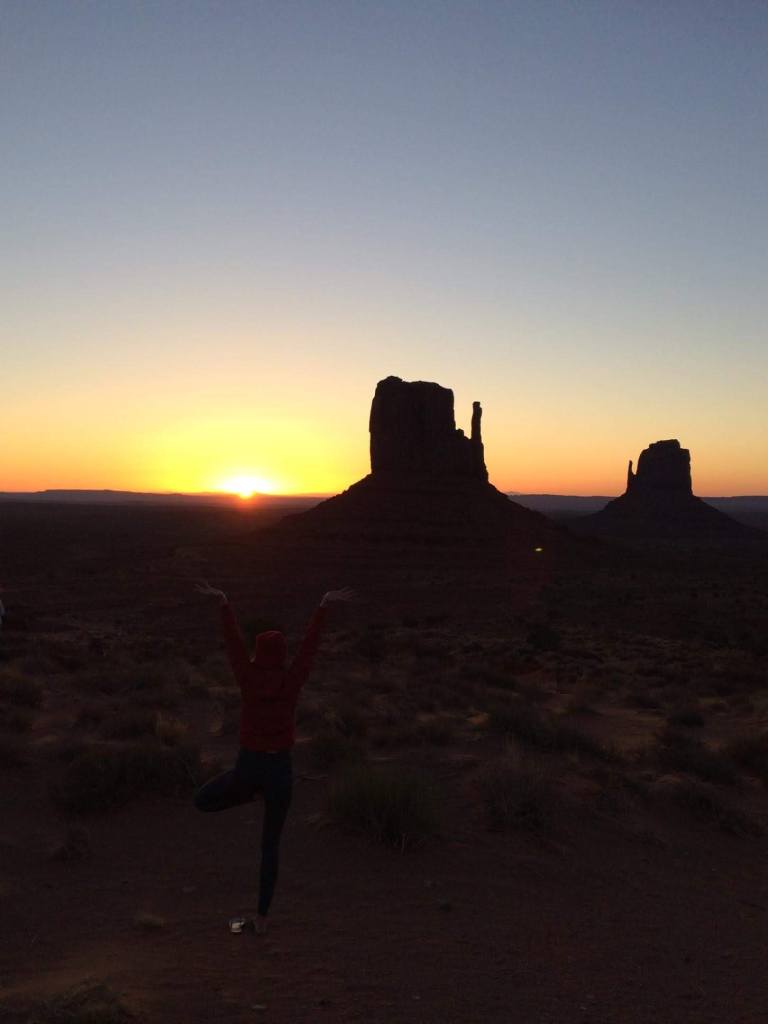
We have always been there, say the Diné, and I know how they know: when you have walked here, the desert paints you in its own image. You cannot be here without the red dust rising from your feet to settle on every inch of skin. How can a people be from somewhere else if they have always worn the red dust, from birth?
And, of course, there is not enough water to submerge yourself in, not unless you travel down, down, down the risky fissure in the world to the San Juan River, and bathe in the inexplicable green.
On the way back up, five-hundred weary feet, you will become red again, unless you should fall. It would be easy, so easy, on the crumbling lip of the desert. Then it would swallow you.
So, if they have always worn the red dust, they have always been here.
-
On Writing: For Campbell
Hi Campbell,I hope you had a lovely, relaxing holiday break. I am sorry this has taken so long. I have been waiting to hear back from my mentor, Sean Murphy, hoping to send his greetings with my answers. He is an award-winning published author and a trainer of young writers, as well as a creative writing professor, etc., etc. He is always very willing to help and it is just a formality that I emailed him to ask if I could give you his email address, but he is also a bit of a digital hermit. Thus, for the time being, I will answer your questions without his response. I am just going to free write in response to your questions, because it appropriately echoes my creative writing process.So! Writing every day… hm, I suppose it is like doing anything every day: hard at first, then easier, and then it becomes hard NOT to! I have gone through that same process with running, yoga, meditation… anything I want to do every day is halting at first. Habit takes time to grow from seed to sapling to tree.I only get to write every day in the summer. When school first gets out, my attention is fragmented, all too used to the rapid-fire, chaos of middle school (“squirrel!”). I sit down for fifteen minutes at a time, write a paragraph, then find myself editing or (alas) net shopping for leggings. Or eavesdropping on strangers’ arguments in a coffee shop or playing with the cat or doing dishes or any of what the zen monks call “the ten-thousand things” that distract us from the creative task.But as I sit down, day after day, the story beckons me onward, gathering an energy and life of its own, far more beguiling than any legging sale or political conversation drifting across the room. My stamina near the end of the summer is easily 2-3 hours at a sitting, about two times a day. I don’t know if that would be the case if I was not working on a narrative: you’d have to ask a journalist, a poet, someone who often writes shorter pieces. It’s beautiful when that happens, akin to “the zone” in sports, samadhi in meditation, a place of utter transcendence that is, truly, the reason I write. Why I must write. Why, no matter if the work is never seen by any eyes but mine, I am utterly addicted and compelled. That is what happens to me when I write every day.I will be honest- good, strong coffee helps, and I did not drink it until I was twenty-three. It does not affect the quality of the work, just the quantity. What I do before writing influences tone and mood, to an extent. I do believe that Earl Grey tea, first thing in the morning, sipped before the magical mists of the night’s dreams have dissipated, produces the best passages. That or an exhilarating run in the foothills: I wrote the backbone of my novel by running after school to really epic music (Metallica, sometimes, “Carmina Burana,” or the Braveheart soundtrack), then bursting into the house, flopping onto the bed, and without preamble, handwriting sweatily until my inspiration was spent. These were always free writes, scattered randomly throughout the eventual plot, full of dashes, and months afterward when I had to spend hours committing them to the digital world I had to superimpose punctuation. This is never a problem when I am not free writing: I am a natural punctuator, but somehow free writing moves too fast. That happens when i write every day: my imagination is much too fast for my hands, whether writing or typing. Sometimes I would record pieces on my phone, pacing and whirling around my house (I lived alone at the time— thank goodness!). To this day, those original post-run or post-sleep passages are some of the best, their texture is so authentic.Are certain kinds of writing better for your brain than others?Well, goodness, I don’t know. I am sure that it depends on the person. I also think that depends on your definition of “brain,” (it felt, mystically, like my body was writing the story after a run) but let’s not get too esoteric here. Ok, yeah, I think different types of writing are good for your brain in different ways, much like different types of exercise benefit the body differently. For instance, to be who I am, to be my best self and feel alive, I have to get some cardio. Sure, I love yoga and I dig any workout, but I really need my heart to pump in that special way it does when I run. Some people (cough, Mrs. Abling) don’t like running. For me, novel-length stories are the same: I just don’t get the same feeling out of any other kind of writing “workout.” Novel writing makes you sensitive to the energetic structure of a long, long work, as well as enhancing your sensitivity to detail. I have friends who are flattened by the idea of writing a novel, but are poets of astounding wit and sensibility. I would say that writing poetry trains your powers of observation, sensitizing you to the subtleties of nature and mind, so even writers who are disinterested in poetry have much to learn from reading and writing it.Nonfiction, “academic” writing, whether a narrative or more essay-style work, makes you disciplined and organized. I can always tell when a student (or a bestselling author) has never really written much to convey actual information because their work often lacks grounding. It seems, to me, abstract and disconnected from reality. Take James Joyce, or Gertrude Stein, or even David Mitchell. Their work is usually unapproachable for me, obviously brilliant but an unearthly, acquired taste. Some people love the purely emotive, surreal, ethereal quality of their work, but it makes me fidgety and restless, craving more of this world. That doesn’t mean they were academics: J.R.R. Tolkien and Phillip Pulman for starters. They had such a solid grounding in how to write informatively about this world that their made up worlds had the same sense of believability as our waking life. In short, I would say academic writing trains to you think critically and deeply about the world, and even the most imaginative work must reflect some of the logical order of this universe.I think. That’s all speculative, but I am sure there is good psychological research on the impact of writing on the brain.I hope this helps- it is delicious to get to talk about, an indulgent feast for me after the dullness of jury selection. I will continue attempting to get ahold of Mr. Sean Murphy, who has written in all the genres discussed above, and would provide more credible perspectives than mine. After all, I am still only an amateur. The word amateur, fittingly, means one who does something out of love (from the french amour). My favorite english teacher taught me that— and now I pass it on to you. May it light the way when society tells you darkly that you must be paid for art in order for it to be worth doing.Blessings on your continued work on this project, I can’t wait for the outcome.Cheers,Ms. Mace -
July 23rd-24th, 2016: Green River, WY to City of Rocks, ID to Glenn’s Ferry ID
July 23rd, 2016, City of Rocks National Monument, Idaho

Dried wild onion with our camping pass.
Having the first moment for myself for a couple of days, I am breaking the breezy evening peace with country music played over my flat-sounding phone speakers. But after a day spent in the car, making the endless considerations for the road trip partners’ happiness, this is perfect.
We are camped in the aptly named City of Rocks National monument, and Dana has gone off to “look at rocks,” which, after a day staring at the road, sounded wholly unappealing.


Stock photo of City of Rocks, because my camera is not that good. Dana “looking at rocks.”
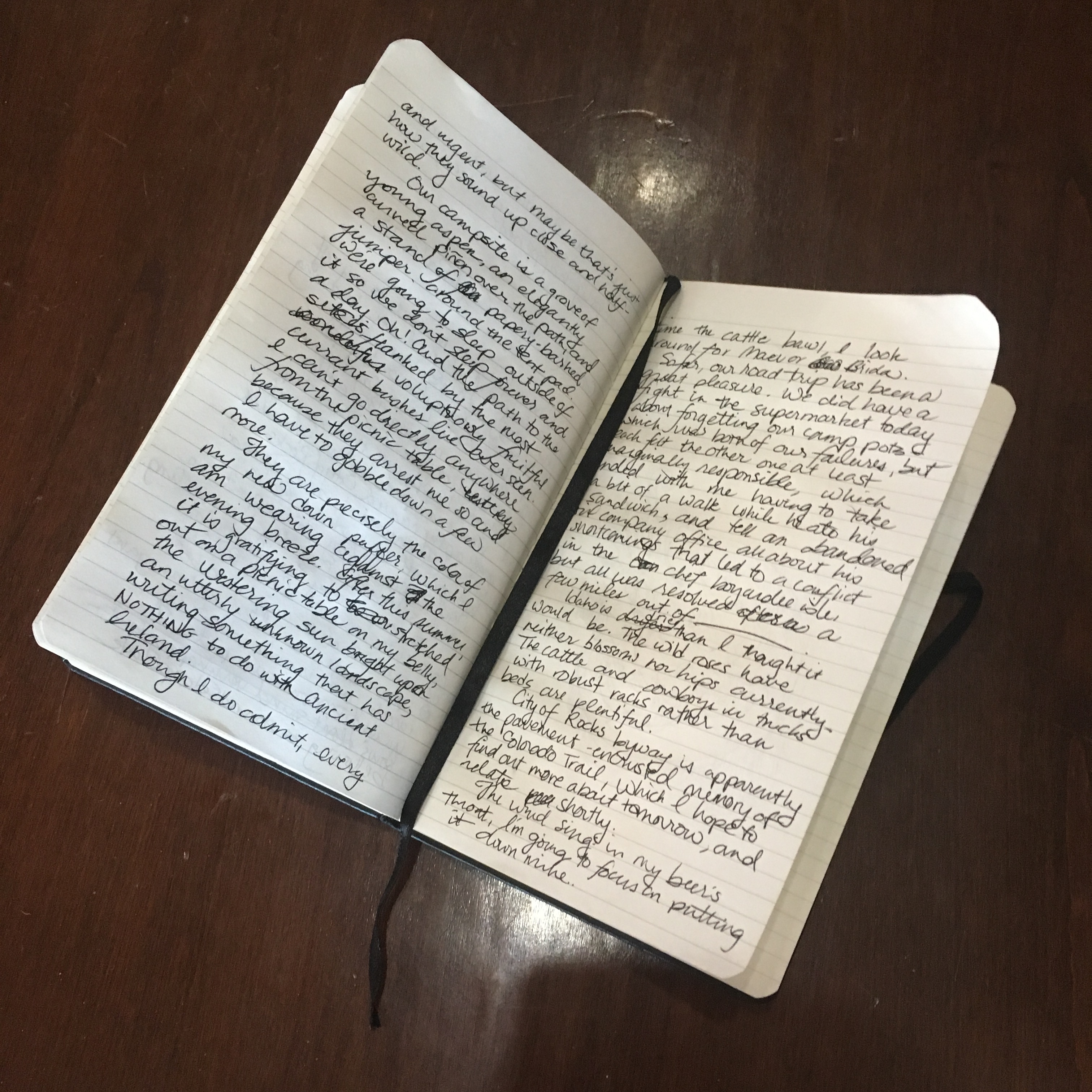
Occasionally the lowing of cows rolls beneath Brad Paisley’s drawl. Open range, or a rather extensive ranch, is only about thirty yards from our campsite. The cows’ bellowing sounds desperate, but maybe that’s just how they sound up close and half-wild.
Our campsite is a grove of young aspen and elegantly curved piñon, and a stand of papery-barked juniper around the tent pad. The path to the site is flanked by the most voluptuously fruitful wax current bushes I have ever seen (and I have seen a lot of wax currents). I cannot go directly anywhere from the tent or the picnic table without stopping to gobble a few fat berries.
They are precisely the color of my new down puffer, which I am wearing against the evening breeze. Dana says it makes me look like “a front-range biddie,” which makes me regret teaching him the word “biddie.”
After this long summer, it is gratifying to be stretched out on a picnic table on my belly, the westering sun bright upon an utterly unknown landscape, writing something that has NOTHING to do with ancient Ireland. Though I do admit, every time the cattle bawl, I look around for Maev or Brida, then remember that they only exist in my brain.
So far, our road trip has been a pleasure. We did have a fight in the Ridley’s supermarket in Malta because we forgot our camp pots. This was a mutual failure, but each felt the other one at least marginally more responsible, which ended with me having to take a bit of a walk while he ate his sandwich, and tell an abandon oil company payroll office all about the incident.


Driving into Idaho/Bear Reservoir in Garden City, Utah/a poor panorama of City of Rocks, an outlook at several formations in City of Rocks- Parking Lot Rock, Morning Glory Spire, The Anthill.
This part of Idaho is drier than I remember it being, so we must have passed through earlier in the summer when we drove it with dad years ago. The wild roses have neither blossoms nor hips currently. The cattle and cowboy trucks with robust racks rather than beds are plentiful.
The wind whistles in the throat of my beer bottle. I am going to take a walk and focus on finishing it before dark.


A pale-pink kind of flax (I think) that is very common here. Blue flax, the periwinkle-hued one common in Colorado, is nowhere to be seen.
July 24th, 2016, City of Rocks National Monument, Idaho
City of Rocks Scenic byway is apparently a branch of the California Trail. We met the evidence as we drove in: one of the rock formations shows the carefully graven names of thousands of wagon-train pioneers. Their handwriting reminded me of the deliberate way that my great-grandmother Willa Dee Hooper used to label photographs, formal lettering in all capitals. The name MACALLISTER dominated the spread, MINNIE-SCOTT-JAMES piled upon one another, covering the bottom ten feet of a fifty-foot boulder.

Again, not my photo. The largest wall of signatures.
Pioneers rejoiced when they reached this destination. I could just picture a cheerful campfire flickering against the signatures on the wall, grateful folk sharing coffee and stories of the road. Surely they exclaimed as the sunset fell across the magnificent Pre-Cambrian formations around them, which they referred to as a “Silent City of Rocks.” One journaler, the excitingly named Wakeman Bryarly, wrote:
[The] road continued between . . . & around these rocky piles but the road itself was good. You can imagine among these massive piles, church domes, spires, pyramids, &c., in fact, with a little fancying you can see [anything] from the Capitol at Washington to a lovely thatched cottage.
I “fancied” them giant prehistoric or alien beasts grazing in green fields, or magnified dust mites. One boulder really did look just like a tardigrade, the microscopic subject of an article in National Geographic. Dana found this obvservation underwhelming, in my opinion.
They bore names like Elephant Rock, Bath Rock and The Breadloaves. The park was well-trafficked, but quiet for the number of travelers. We climbed two 5.8 routes on Elephant Rock, mostly flake-systems of cracks. Dana climbed a steep 5.10 on The Breadloaves dubbed “Bloody fingers,” but that was hyperbolic. There was a wildly difficult start and a “scary” part at the top, but he ascended peacefully and with no blood whatsoever.
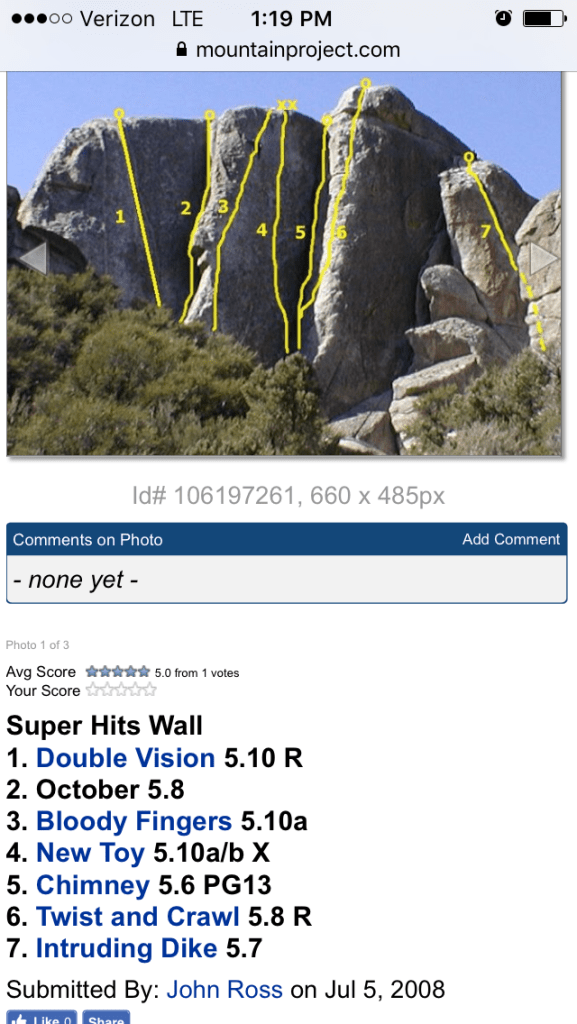
Dana climbed #3, both lead and TR.
I tried it also, but flailed about at the bottom and found no strength to even aid up it. After this, I needed to redeem myself, so we climbed “_____? Rasmussen” 5.8 a little ways along. It was a properly torturous crack: not dangerous or long, but demanding crack-climbing techniques, which are painful and harmless and thrilling. It has the honor of being the first route that I got my foot legitimately stuck in, and had to be lowered a few feet in order to free it. I can assure you that I ascended cursing and shouting, which is how you can tell how good a crack climb it is. I disturbed many a fellow climber and more than a few rock pigeons. This one was excellent.
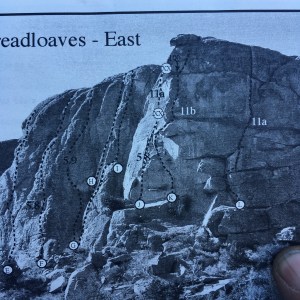
Final route was the crack labelled ‘J,’ 5.8.
I felt satisfied after that, and we scrambled down to the old-fashioned hand-pump for water. It was icy cold as it was sucked up from the depths of the earth, and I rinsed my hair and feet, exultant.
Then we turned left out of the Emory Picnic grounds parking lot. It was eleven miles on a dirt road to Oakley and another thirty to Burley, Idaho. I think that is the town Granddad declares the halfway point to Oregon, but that must be based on leaving Pueblo. In any case, these pioneers headed onward, to Glenn’s Ferry.
-
July 22nd, 2016: Golden, CO to Green River, WY
We spent the first night of our trip along a tributary of the Green River called Black’s Fork in the southwestern reaches of Wyoming, just short of the Utah border.
We pulled off Scenic Byway 530 onto a dirt track worn by oil exploration and drove in a half-mile to a pullout looking toward the river over a dried mud flat. There we got out and stretched, and considered walking to the river against the cliffs nearby.
After a few steps across the cracked surface, we realized, with sideways hopping and whooping, that the hard crust was only a superficial layer over several feet of spongey grey mud. We were in no state to prevail in the dark through possible quicksand.
So we gave up and wobbled back to solid land, which we found to be impenetrably so when we tried to sink tent stakes into the table-hard ground. Knocking on it produced satisfying noises, but otherwise it was a useless effort. Dana found a rock and managed an ineffectual couple of inches. It is always wise to stake a tent in Wyoming, which is the windiest state I know of. If you cannot, you must at least try, so as to assuage the wind gods of that place, who are boisterous and easily offended.
Yet the night was warm and only a gentle breeze stirred the sagebrush and other impoverished members of the vegetal community. We gave a bit of lip service to our 3.2 beers, but soon settled on our backs to watch the stars come out.
Scorpio was emblematically stretched across the sky to the southwest, the dipper poured upside-down in the north. Our tent sat unoccupied as we lay side beside beneath a silent, splendid sky.
We drifted off to sleep. Then the waning gibbous moon rose so bright and yellow that Dana muttered, “What’s that?” in his sleep as it broke a cloud bank. “The moon,” I answered, and it was striking after the darkness of the star fields.
Alas, the tranquility was for the early night in the desert, much as dawn is the quiet time in a town. First, it was a lone killdeer calling repeatedly on the mud flats, perhaps to keep some predator from her nest. Then a pack of coyotes started up in the distance, their voices echoed by the cliffs. I could only pick out three or four individual voices. In arid country, everything has small families except the cattle.
After a while, a hoot owl took up a soft but steady conversation with the darkness, and the killdeer joined in from time to time. This continued regularly for a maddening while. Just as I was getting accustomed to the noise and slipping back into sleep, a spastic exclamation woke both of us.
Dana raised his head like a seal—he was sleeping on his belly—and I half-rose on my elbows.
“That’s close,” he said. It was a coyote making a distinctive bark that gave way to a whining howl at the end. She couldn’t have been more than twenty feet away.
I started speculating aloud about the purpose of her barks, which were uniform and urgent. I have lived in coyote country all my life, and I know that this is unusual for a coyote. They usually make noise in packs, and they keep the pattern scattered and random to sound like a larger pack. Was she announcing herself to us, determined to intimidate us away from her den? Was she calling for a pup? Or both? Dana seemed either unconscious or disinterested in my theories.
By this time, the sky was lightening behind the riparian cliffs, and I gave up on falling asleep, which promptly happened.
The next morning, we braved the thick, gooey mud to get to the river, and enjoyed the sun cresting the cliffs and sparkling on the water. Then we went for a run in the already-blazing nine-AM run, with a stop to view the meanders of the river from a cliff top.
On our drive out, we stopped in town at a place called Expedition Island. Dana grew excited at the reason for this name: a sign announced this as the official “put-in” for the Powell Expedition that travelled and mapped the Green River and the Colorado River in 1869. Some years ago, when he was preparing to kayak the same waters, Dana read his account of the journey. He has relayed it to me many times, in bits and pieces, and I will do my best here, with occasional help from Wikipedia, because Dana is busy.
John Wesley Powell was a Mississippi waterman and a professor of geology in Illinois. Like most men of the time, he was swept up into the Civil War, and fought as a major for the Union. At the Battle of Shiloh, he was hit by a miné ball in the arm, and (inevitably) his forearm had to be amputated. So bear in mind that he did everything else I am about to relay with one hand.
After the war, he poured west with many of the still-enlisted soldiers. Instead of getting into disastrous confrontations with Native Americans, like most of the military, Powell led ten men on an expedition to explore the Grand Canyon.
The expedition started off rather badly, losing a boat called No Name (although it surely is more accurate to call it an unnamed cargo boat!) with their supplies and barometers. They recovered some of the barometers, which were very important for determining altitude. One cannot explore the rivers of the mountain west without carefully noting the altitude in one’s oilskin-covered journals!
The expedition went along mapping and notating, keeping themselves on flour, coffee, and dried apples and whatever they could reel in. Dana chose to mimic this on one of his journeys, demonstrating a sensibility that I love in him. On his night to cook, he provided coffee, biscuits, and a the fish he had caught.
The Powell expedition lost a few men. Three abandoned the trip in fear, but died mysteriously trying to find their way out. Another went to live with the Paiutes and then the Mormons. Five or six, depending on which account you read (or how many hands you have) made it to the official conclusion of the expedition.
We found the waters near the pull-of site sparkling clean and fresh, the perfect depth for swimming without any worry of becoming a permanent resident of the river. To my delight, we spotted two white and grey feral kittens, but they refused my advances and disappeared into a thicket. We stretched while watching the residence of the town prepare for a bouncy-castle festival, the lush green of the riparian park a relief after the hard-packed desert.
Now we are off to Idaho, literally to greener pastures.
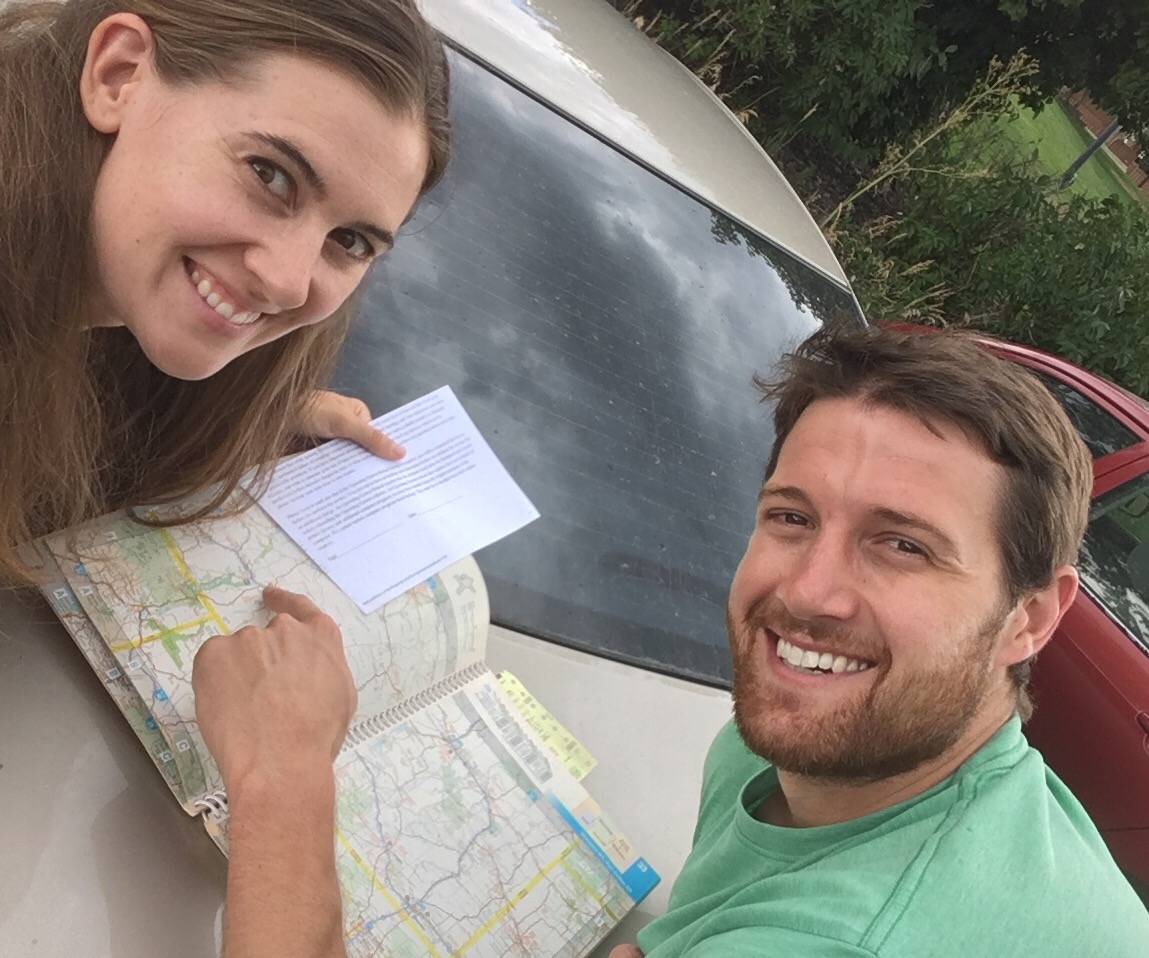
 Laura Catherine Mace