Author: lormace

  • July 23rd-24th, 2016: Green River, WY to City of Rocks, ID to Glenn’s Ferry ID


    July 23rd, 2016, City of Rocks National Monument, Idaho
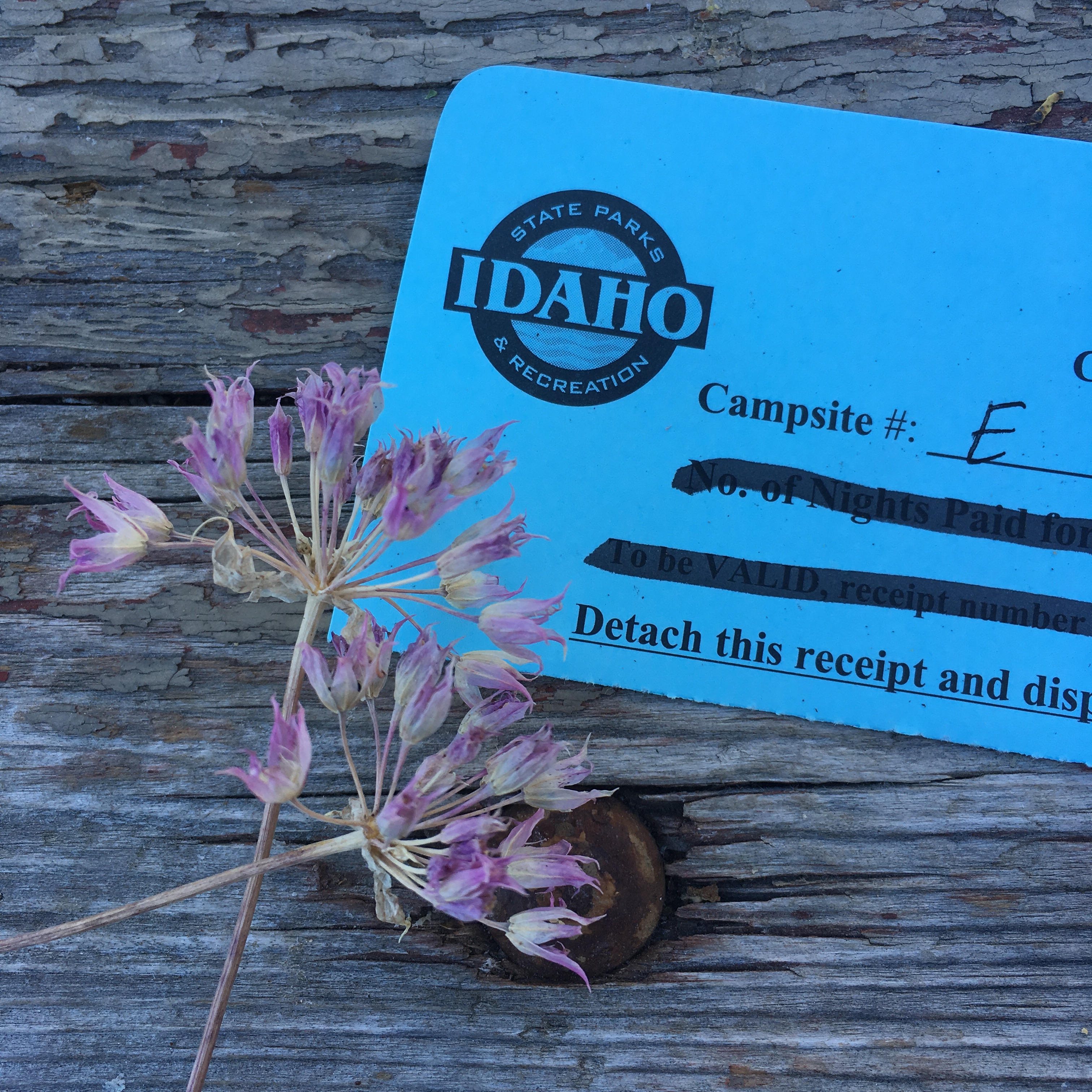
    IMG_1664

    Dried wild onion with our camping pass.

    Having the first moment for myself for a couple of days, I am breaking the breezy evening peace with country music played over my flat-sounding phone speakers. But after a day spent in the car, making the endless considerations for the road trip partners’ happiness, this is perfect.

    We are camped in the aptly named City of Rocks National monument, and Dana has gone off to “look at rocks,” which, after a day staring at the road, sounded wholly unappealing.

    Stock photo of City of Rocks, because my camera is not that good. Dana “looking at rocks.”

    Occasionally the lowing of cows rolls beneath Brad Paisley’s drawl. Open range, or a rather extensive ranch, is only about thirty yards from our campsite. The cows’ bellowing sounds desperate, but maybe that’s just how they sound up close and half-wild.

    Our campsite is a grove of young aspen and elegantly curved piñon, and a stand of papery-barked juniper around the tent pad. The path to the site is flanked by the most voluptuously fruitful wax current bushes I have ever seen (and I have seen a lot of wax currents). I cannot go directly anywhere from the tent or the picnic table without stopping to gobble a few fat berries.

    They are precisely the color of my new down puffer, which I am wearing against the evening breeze. Dana says it makes me look like “a front-range biddie,” which makes me regret teaching him the word “biddie.”

    After this long summer, it is gratifying to be stretched out on a picnic table on my belly, the westering sun bright upon an utterly unknown landscape, writing something that has NOTHING to do with ancient Ireland. Though I do admit, every time the cattle bawl, I look around for Maev or Brida, then remember that they only exist in my brain.

    So far, our road trip has been a pleasure. We did have a fight in the Ridley’s supermarket in Malta because we forgot our camp pots. This was a mutual failure, but each felt the other one at least marginally more responsible, which ended with me having to take a bit of a walk while he ate his sandwich, and tell an abandon oil company payroll office all about the incident.

    Driving into Idaho/Bear Reservoir in Garden City, Utah/a poor panorama of City of Rocks, an outlook at several formations in City of Rocks- Parking Lot Rock, Morning Glory Spire, The Anthill.

    This part of Idaho is drier than I remember it being, so we must have passed through earlier in the summer when we drove it with dad years ago. The wild roses have neither blossoms nor hips currently. The cattle and cowboy trucks with robust racks rather than beds are plentiful.

    The wind whistles in the throat of my beer bottle. I am going to take a walk and focus on finishing it before dark.

    A pale-pink kind of flax (I think) that is very common here. Blue flax, the periwinkle-hued one common in Colorado, is nowhere to be seen.

    July 24th, 2016, City of Rocks National Monument, Idaho

    City of Rocks Scenic byway is apparently a branch of the California Trail. We met the evidence as we drove in: one of the rock formations shows the carefully graven names of thousands of wagon-train pioneers. Their handwriting reminded me of the deliberate way that my great-grandmother Willa Dee Hooper used to label photographs, formal lettering in all capitals. The name MACALLISTER dominated the spread, MINNIE-SCOTT-JAMES piled upon one another, covering the bottom ten feet of a fifty-foot boulder.

    black-signatures

    Again, not my photo. The largest wall of signatures.

    Pioneers rejoiced when they reached this destination. I could just picture a cheerful campfire flickering against the signatures on the wall, grateful folk sharing coffee and stories of the road. Surely they exclaimed as the sunset fell across the magnificent Pre-Cambrian formations around them, which they referred to as a “Silent City of Rocks.” One journaler, the excitingly named Wakeman Bryarly, wrote:

    [The] road continued between . . . & around these rocky piles but the road itself was good. You can imagine among these massive piles, church domes, spires, pyramids, &c., in fact, with a little fancying you can see [anything] from the Capitol at Washington to a lovely thatched cottage.

    “fancied” them giant prehistoric or alien beasts grazing in green fields, or magnified dust mites. One boulder really did look just like a tardigrade, the microscopic subject of an article in National Geographic. Dana found this obvservation underwhelming, in my opinion.

    They bore names like Elephant Rock, Bath Rock and The Breadloaves. The park was well-trafficked, but quiet for the number of travelers. We climbed two 5.8 routes on Elephant Rock, mostly flake-systems of cracks. Dana climbed a steep 5.10 on The Breadloaves dubbed “Bloody fingers,” but that was hyperbolic. There was a wildly difficult start and a “scary” part at the top, but he ascended peacefully and with no blood whatsoever.

    IMG_1619

    Dana climbed #3, both lead and TR.


    I tried it also, but flailed about at the bottom and found no strength to even aid up it. After this, I needed to redeem myself, so we climbed “_____? Rasmussen” 5.8 a little ways along. It was a properly torturous crack: not dangerous or long, but demanding crack-climbing techniques, which are painful and harmless and thrilling. It has the honor of being the first route that I got my foot legitimately stuck in, and had to be lowered a few feet in order to free it. I can assure you that I ascended cursing and shouting, which is how you can tell how good a crack climb it is. I disturbed many a fellow climber and more than a few rock pigeons. This one was excellent.

    IMG_1665

    Final route was the crack labelled ‘J,’ 5.8.

    I felt satisfied after that, and we scrambled down to the old-fashioned hand-pump for water. It was icy cold as it was sucked up from the depths of the earth, and I rinsed my hair and feet, exultant.

    Then we turned left out of the Emory Picnic grounds parking lot. It was eleven miles on a dirt road to Oakley and another thirty to Burley, Idaho. I think that is the town Granddad declares the halfway point to Oregon, but that must be based on leaving Pueblo. In any case, these pioneers headed onward, to Glenn’s Ferry.


  • July 22nd, 2016: Golden, CO to Green River, WY

    We spent the first night of our trip along a tributary of the Green River called Black’s Fork in the southwestern reaches of Wyoming, just short of the Utah border.

    We pulled off Scenic Byway 530 onto a dirt track worn by oil exploration and drove in a half-mile to a pullout looking toward the river over a dried mud flat. There we got out and stretched, and considered walking to the river against the cliffs nearby.

    After a few steps across the cracked surface, we realized, with sideways hopping and whooping, that the hard crust was only a superficial layer over several feet of spongey grey mud. We were in no state to prevail in the dark through possible quicksand.

    So we gave up and wobbled back to solid land, which we found to be impenetrably so when we tried to sink tent stakes into the table-hard ground. Knocking on it produced satisfying noises, but otherwise it was a useless effort. Dana found a rock and managed an ineffectual couple of inches. It is always wise to stake a tent in Wyoming, which is the windiest state I know of. If you cannot, you must at least try, so as to assuage the wind gods of that place, who are boisterous and easily offended.

    Yet the night was warm and only a gentle breeze stirred the sagebrush and other impoverished members of the vegetal community. We gave a bit of lip service to our 3.2 beers, but soon settled on our backs to watch the stars come out.

    Scorpio was emblematically stretched across the sky to the southwest, the dipper poured upside-down in the north. Our tent sat unoccupied as we lay side beside beneath a silent, splendid sky.

    We drifted off to sleep. Then the waning gibbous moon rose so bright and yellow that Dana muttered, “What’s that?” in his sleep as it broke a cloud bank. “The moon,” I answered, and it was striking after the darkness of the star fields.

    Alas, the tranquility was for the early night in the desert, much as dawn is the quiet time in a town. First, it was a lone killdeer calling repeatedly on the mud flats, perhaps to keep some predator from her nest. Then a pack of coyotes started up in the distance, their voices echoed by the cliffs. I could only pick out three or four individual voices. In arid country, everything has small families except the cattle.

    After a while, a hoot owl took up a soft but steady conversation with the darkness, and the killdeer joined in from time to time. This continued regularly for a maddening while. Just as I was getting accustomed to the noise and slipping back into sleep, a spastic exclamation woke both of us.

    Dana raised his head like a seal—he was sleeping on his belly—and I half-rose on my elbows.

    “That’s close,” he said. It was a coyote making a distinctive bark that gave way to a whining howl at the end. She couldn’t have been more than twenty feet away.

    I started speculating aloud about the purpose of her barks, which were uniform and urgent. I have lived in coyote country all my life, and I know that this is unusual for a coyote. They usually make noise in packs, and they keep the pattern scattered and random to sound like a larger pack. Was she announcing herself to us, determined to intimidate us away from her den? Was she calling for a pup? Or both? Dana seemed either unconscious or disinterested in my theories.

    By this time, the sky was lightening behind the riparian cliffs, and I gave up on falling asleep, which promptly happened.

    The next morning, we braved the thick, gooey mud to get to the river, and enjoyed the sun cresting the cliffs and sparkling on the water. Then we went for a run in the already-blazing nine-AM run, with a stop to view the meanders of the river from a cliff top.

    On our drive out, we stopped in town at a place called Expedition Island. Dana grew excited at the reason for this name: a sign announced this as the official “put-in” for the Powell Expedition that travelled and mapped the Green River and the Colorado River in 1869. Some years ago, when he was preparing to kayak the same waters, Dana read his account of the journey. He has relayed it to me many times, in bits and pieces, and I will do my best here, with occasional help from Wikipedia, because Dana is busy.

    John Wesley Powell was a Mississippi waterman and a professor of geology in Illinois. Like most men of the time, he was swept up into the Civil War, and fought as a major for the Union. At the Battle of Shiloh, he was hit by a miné ball in the arm, and (inevitably) his forearm had to be amputated. So bear in mind that he did everything else I am about to relay with one hand.

    After the war, he poured west with many of the still-enlisted soldiers. Instead of getting into disastrous confrontations with Native Americans, like most of the military, Powell led ten men on an expedition to explore the Grand Canyon.

    The expedition started off rather badly, losing a boat called No Name (although it surely is more accurate to call it an unnamed cargo boat!) with their supplies and barometers. They recovered some of the barometers, which were very important for determining altitude. One cannot explore the rivers of the mountain west without carefully noting the altitude in one’s oilskin-covered journals!

    The expedition went along mapping and notating, keeping themselves on flour, coffee, and dried apples and whatever they could reel in. Dana chose to mimic this on one of his journeys, demonstrating a sensibility that I love in him. On his night to cook, he provided coffee, biscuits, and a the fish he had caught.

    The Powell expedition lost a few men. Three abandoned the trip in fear, but died mysteriously trying to find their way out. Another went to live with the Paiutes and then the Mormons. Five or six, depending on which account you read (or how many hands you have) made it to the official conclusion of the expedition.

    We found the waters near the pull-of site sparkling clean and fresh, the perfect depth for swimming without any worry of becoming a permanent resident of the river. To my delight, we spotted two white and grey feral kittens, but they refused my advances and disappeared into a thicket. We stretched while watching the residence of the town prepare for a bouncy-castle festival, the lush green of the riparian park a relief after the hard-packed desert.

    Now we are off to Idaho, literally to greener pastures.


    img_1614

    IMG_1673

  • Celebrities, Social Media, and (not) the Moon

    I started thinking about this today while I was discussing ancient myths with my seventh grade students. When you hear a mythical story, are you knowing the celebrities of yore? Totally.

    Humans weren’t all of struck by a sudden fascination with larger than life characters when cameras and film are invented- no way!

    People followed the lives of nobility and monarchs. They spun elaborate yarns about heroes and gods. Basically, we need these archetypes, these relationships to unreal beings. Most celebrities and politicians will always be imaginary to regular folks. Only a tiny percentage of people personally know Brad Pitt, Taylor Swift or the Pope. Folks just know about them second-hand, the way you know a fictional character in a book or a movie or something. So we are still in this myth-making place where humans will probably stay.

    The mythical imagination grows our lives. We call it inspiration, viewing something more sublime and perfect than reality so that we can move toward it. In an interview about her marriage, professional volleyball player Gabby Reese “There is life, and then there’s the theater of life. We need more of the real stuff.”

    Nowadays, everyone has a web-presence, a virtual identity through Facebook or Instagram or Twitter (or a blog!). We all exhibit our doings to the world in a way that used to be unique to public figures: photographs and videos, opinions, statistics. How should we relate to that mythical representation of ourselves?

    I think some folks literally worship it, you know, distilling every experience into code. We all know that woman who only sees a beautiful sunset on her phone screen as she takes a selfie, that guy who never works out without taking a mirror shot.

    Others are more detached and use social media mainly for communicating with friends and family. It is fascinating to watch all of this develop, and I think it adds a whole new dimension to the questions of human self-concept and mythological imagination.

    “If a tree falls in the forest but no one hears it…” If I hike up a mountain but do not take any pictures, did it really happen? We could get depressed about how into their mythological online lives some people are, but I think the really important thing is that we call it what it is: an imaginary world. An unreality- and relate to it as such. Like it or not, social media now has an important role in supporting communities. It efficiently orchestrates things that happen in the physical world, everything from elections to concerts to medical decisions.

    We have to mentally adjust, the way that people did to television and radio, even the printing press (Ah, Gutenberg, you have made manuscripts too cheap and now people are reading their lives away instead of spending quality time with their hogs)!

    Even language itself created symbolic worlds and mythological identities for the speakers. As the Surangama Sutra explains, a word is like a finger pointing at the moon, it is not the moon itself. A word is not the thing it describes, so it takes imagination to even use language. We step away from reality when we but hear a sentence.

    I guess what I am getting to is this: Keep your social media accounts, but remember that life is still so much bigger than anything we can say (or tweet) about it.

    Ah, the irony of this post…

    Click here to read more of the Surangama Sutra.

  • Nature: So much more than an amusement park

    Two mornings ago, I was standing atop Long’s Peak with, oh, thirty other people. Long’s is a Colorado monarch, the northernmost fourteener of over fifty in my home state. It’s a darn tough, technical, mountain climb, and obsessively crowded.  Most of the folks on the summit were like me, in their twenties or thirties, many native Coloradans, but European and Asian and Texan as well. They had come in groups and were laughing and smiling, striking victory poses for their busy cameras.

    The view was heart-stopping, of course. I say of course to register my surprise that the view was not transporting me to a place of silent awe. I had expected a spiritual rush, a sense of oneness with a great and terrible world. Instead, all I felt was relief, a sense of accomplishment, and a dread of the part of the descent called “The Trough” which (I humbly felt) was downright deadly. 

    Perhaps I was seeking to do what John Muir meant when he said, “Keep close to Nature’s heart… and break clear away, once in a while, and climb a mountain or spend a week in the woods. Wash your spirit clean.” Nor did it feel like a great feat of conquest,  or even a Tibetan sense of unity with the mountain. 

    And why not?! The tens of thousands of acres I could see contained everything I see and do and hear, day after day, living my ant life below. The hues of that ethereal world, from jay-feather indigo to midnight, hazy green to velvety whale grey, were splendidly draped over the voluptuous world of stone. There, it was plain that we are part of only a thin film of life on an impossibly giant, heavy metabolism of rock. But I was tired and in no way could I feel related to the view before me.

    It is tempting to blame my mediocre mood on all the noisy folk taking selfies and devouring packaged snacks. The other hominids up there with me were not treating this space at the top of the world, that we had run a gauntlet for the privilege to attend, as a temple. No, the atmosphere was more like some combination of amusement park and graduation ceremony, a thrill and an achievement. Which, my aching lungs attested, it certainly was.

    When George Mallory set out to summit Everest in 1924, the shocked and titillated Victoria world asked him why he should do such a thing. “Because,” Mallory famously replied, “It is there.” Mallory had climbed many of the world’s great mountains, and he had great respect for the power of nature. He was not a brash man, but a bold one. Yet, his was a path of conquest and exploration, not of worship and unity with nature. Perhaps sensing this, the Tibetan shamans in the village where he prepared for his ascent told him that his journey was cursed, the mountain would cast him down for his arrogance, his otherness. Sadly, their predictions came true, and Mallory died on the eighth or ninth of June, 1924. He may have summited, the first person on record to climb to the roof of the world. We will never know for certain.

    His words have inspired generations of mountaineers, and none in greater numbers than today’s young climbers. Like other outdoor sports, mountaineering is more popular now than ever before, with record numbers of alpine, aid, traditional and sport climbers crawling over states like Colorado. 

    Extreme skiing, paragliding, diving, every single sector of the outdoor adventure market grows by more than eight percent a year. Most of the participation is by twenty to thirty-five year olds, including record numbers of women and minorities filling up skydiving cabins and ski lifts. As a generation, millennials are wildly adventurous. George Mallory would have been aghast at the lines of climbers who now ascend Everest, and not without risk. Mountains are still physical tests of human mettle, obstacle courses for muscle and will. 

    I admire the impulse to meet nature’s challenges immensely, if a little short on it myself. My climbing partner on Long’s that day was the first to quote Mallory to me, as an explanation for his love of these long treks to the ceiling of creation. I feel that Mallory (he was a great writer of letters) and adventurers of his ilk have explained their lust beautifully, and I highly recommend reading their journals and correspondence. 

    I would like to suggest that we modern adventurers might treat the hundred-people-a-day summits of Colorado with greater reverence and less frivolity. What comes to mind are the small signs requesting that visitors to cathedrals maintain a reverent silence. Organized religion is well aware that there is a level of human consciousness that cannot be achieved when one is babbling about which instagram filter to use (those same cathedrals usually have bans on cameras). 

    Awe is the special ward of silence, the childish innocent of the mind’s multitudes that can only be coaxed forward in the absence of more mundane characters. Apart from any fresh winds that might be blowing, mountaintops are some of the most strikingly silent places in the wilderness. In that void, I might have been lucky enough for that wordless, guileless feeling of grace that only the very sacred can instill. 

    If a man-made structure is deserving of respectful silence, so must the summit of a mountain. Surely no one on Long’s with me that day could truly sustain the idea that she had conquered anything. In a moment the air could shift and we would all find ourselves at the mercy of the fervent charge between cloud and rock. We would not be conquerors at all, but frightened animals scrambling for shelter, ill-suited to survival at 14,259 feet. Alas, if we consider ourselves mountain-masters, we are nothing compared to the fat, fuzzy marmots stealing the crumbs of our granola bars.

    I do not want to belittle the accomplishments of my fellow outdoor enthusiasts. The glory of such a rite of passage is real, it is not merely Western or modern to feel. I know that the young and strong of every culture set and embrace obstacles. I can envision young Hawaiians scaling the Nepali cliffs to lounge in rich, high valleys. I know that Paiute and Tiwa and other mountain tribes went on vision quests to mountain tops, and surely some whooped and hollered in exhilaration when they reached the top. Since the dawn of our kind, we have literally left our hands and footprints in a wildly extreme place to say, pre-Instagram, “I, Homo sapien sapien, was here!”

    I definitely don’t like the idea of the forest service posting SILENCE PLEASE signs at the summit of every Colorado fourteener. I think the world would be a little duller if young adventurers suddenly stopped high-fiving each other and took on the demeanor of monks. I only want to remind us all that there is an opportunity for something other, something more.

    There is a time for silence on mountaintops, to let the enormity of where you are crash through the crusty levels of your everyday consciousness and sink in. Give eternity a few moments (for eternity is, after all, not in a rush) before reaching for your camera to truly make the memory you are trying to preserve and share. Be fully present to the utter absurdity of your physical location. Know how tiny you are. Your body has just struggled to get here because you are so small in relation to this great word, or this would be no achievement at all. Your dizziness, your palpable pulse, your eyes boggling at the vista are all telling you how alive and mortal you are, and how acutely you are connected to the vast, vast cosmos.

    On our hike down, in the Alpenmeadows above the treeline, my climbing partner stopped suddenly with a breathless, “Oh!” A herd of elk were moving brownly and confidently up the slope toward us. I sighed, and involuntarily moved toward them, mesmerized. The impressive mountaineering women I had just watched bounce down an ice-slide with an axe and spiked boots swept by, unaware or uninterested in the elk, chattering and laughing. I flung myself onto a boulder on my belly to watch the herd graze, trying not to startle them. 

    There were about a dozen cows and one placid bull, all browsing on the grasses and wildflowers that gushed from the rocky soil of the mountainside. They regarded me impassively, concluding with flicks of their ears that I was not dangerous. 

    I felt my own aching legs and watched theirs power them easily up the slope, their great bodies built from plants that would do very little, nutritionally, for me. Their heavy bones were made of the mountain itself, pulled from its sides by tiny grasping roots, eaten, then assembled into this sentient herd. 

    As we watched, Dana said, perfectly, “I always forget that they spend their whole lives out here with nothing but fur. Just always here.”

    “Yes,” I said, finally feeling the transcendence I had missed on the mountaintop, “Their world goes on forever.”

  • Surfing, Silphium and Time Travel (but not as exciting as that sounds)

    Today I got home from school, napped, and consumed a load of carbs- my usual Wednesday afternoon dwindle to a near halt. When I woke up, work was still washing up on the shores of my mind like a stupid duck-shaped paddle boat that someone forgot to tie to the dock. So I planned some objectives and KUD’s for the week. After stashing that acronym salad in my google drive, I tucked my book under my arm and grabbed a violet striped pool towel. Time to immerse.

    The pool was Disney-blue, smelling strongly of chlorine and exploding with puberty in the form of two boys and two girls who were engaged in a hormone-fueled battle. The boys had makeshift water guns of plastic tubing that they had dubbed “sausages.” They were using them (inventively) to spray the girls with water in the kind of blatant innuendo that thrills the adolescent male psyche and makes everyone else reconsider the sexual philosophies of the Puritans. In the process, my book got fairly wet.

    It is The Wave by Susan Casey. I was transitioning from the chapter on a wave-physics conference to one about wealthy superstar surfers eating a breakfast of ahi, fruit and Hawaiian coffee in a shack off of Pe’ahi. I had been within twenty miles of the place, oh, three or for years ago on vacation. Reading about a Hawaiian morning is always unbearable if you are not there, but Golden was doing its best to make up for it by dropping the sun dramatically behind its bluffs in a haze of white-gold that set the pool water and the maple leaves aglitter.

    Eventually, I put the book down and spent some time pondering the past and the future. The other day at the start of our staff meeting in the library, a realization hit me like a collapsing bookshelf. The librarian of my consciousness was crushed beneath it for a moment, and I was left gazing blankly at the ceiling until Brady Yarletts, our very bright-eyed math teacher, asked me what I was staring at.

    “I’ve just realized,” I explained, “that my entire job, all day, is to think about what is happening and connect it to the past. I talk about dead people all day. You work with stuff that IS, or will be, The things I talk about are over.

    His eyes widened boyishly, “That’s true. I never thought about that. Huh. Weird.”

    I went on, warming to the topic, “It’s like I am some dreadful Epimethean character in a Greek tragedy.”

    “What?”

    “Nevermind.”

    It is true. Lately I have been struck by how little regard I give the present world. It is as though everything I see has its history or legacy drifting behind it like an old cloak. My mind runs on something like this:

    “Controversy over reproductive rights, you say? Did you know that one of the most effective contraceptive techniques in the classical world was the consumption of silphium seeds, which came from a species of Giant Fennel that grew exclusively in an ecological niche near the North African city of Cyrene? Indeed, the plant was such a success that, after it was discovered by Roman dominas and prostitutes, it was harvested to extinction within decades. It was also a perfect heart shape, which is possibly where our current symbol comes from!”

    …. and the like.

    “I am already like some crotchety old scholar whose eyes are so fogged with lore that he can’t see out the window,” I mumbled to Yarletts as the meeting got underway, “I am going to be unbearable when I am old.”

    He laughed good-naturedly and turned his present, thoughtful mind to his weekend plans, which we discussed in whispers while I formed a resolution. I think it will be critical to keep throughout my years as a history teacher:

    The past, in a sense, is fake. It is gone, and all we can see are the affects it has on the present. It is much like a wave, really- the only reason we see “a wave” is because we see the water low at one moment, high the next, and our brain connects those visions into the idea of a trough and a crest. But zen (my ultimate authority on most matters, for some reason) would suggest that life is found in each moment, that the experience of a wave is wherever you are in relation to where it is now.

    I think surfers would agree. Be. Don’t always swim at the crest of a bunch of mental stories, no matter how well-researched. Try to live on the threshold of the real, ever-present. Enjoy the story of history, and give it its place and time. But “let the soft animal of your body love what it loves” (Mary Oliver, “Wild Geese”) without the trappings of knowledge weighing down every insight. Learning must be connected to life, but there is a point where it becomes such a filter for experience that we cease to breathe here and now.

    At least, that’s how I feel today.

    Ciao!

  • Letter from my 90-year old self

    Some Tuesday morning perspective:

    Dear, Dear One,

    This life is too short to spend one more minute of it fretting. Trust me— who knows how many more sunrises I (you) will see? Let go. You can’t control the future. The things you think are worth worrying about are just heartbeats, dust, nothing. Eternity is ours, but this short time as a crazy being embodied in blood and bone on this spinning rock is something precious. 

    Love is beautiful and not as hard a you think. Relax and let people be who they are—they will anyway! You will only regret any time you spend trying to force your will on, well, anything.

    Do not worry about working your life away. Work is a blessing. It connects you to the wider world. In balance, it gives you a channel for your energies and gifts, and it even gives energy, gives life back when undertaken in the right spirit.

    Embrace the chaos of living. Keep things simple. Never take this sweet strange existence for granted.

    I love you.

    Sincerely,

    Laura 

  • Notes from a run at sunset

    This, this that I call my self,
    Is a bridge only.
    What the God of suns and stars does behind my skull, in my veins and ventricles,
    I cannot fathom
    What the God of my heart does outside my flesh,
    What God does with wind and tree and rock,
    And the exhalations and inhalations of time,
    I cannot control.
    We all, human,
    are the tender children of this Middle-Earth,
    Hopeful followers of the Middle-Way, drawn for us across the sky
    Remember, you are the bridge keeper
    between God within,
    and God without.
    Amen.

  • The Path of Writing | Tricycle

    Interesting expression of one author’s experience in relation to Søren Kierkegaard’s existential questions.

    The Path of Writing | Tricycle.

  • Recommendation: “The right to be forgotten, or how to edit your history”

    Peter Fleischer: Privacy…?: The right to be forgotten, or how to edit your history.

    A comprehensive and easy to read overview of internet privacy issues, the European droit “a l’oubli,” straight from the horse’s mouth: that of Peter Fleischer, Google’s privacy policy director.

    The whole blog is a must-read, really.

  • Recommendation: The Write Priorities by Sean Murphy

    An examination of how to prioritize writing in your life, with Sean Murphy’s ever-moderate, equivocal and clear insights.

    Newsletter – Sean Murphy.

    Sean has been my zen teacher since I was a little squirt, just out of college. His tone alone teaches me much about meditation, writing, and goals in life.

    Enjoy!