Category: Musings

  • Celebrities, Social Media, and (not) the Moon

    I started thinking about this today while I was discussing ancient myths with my seventh grade students. When you hear a mythical story, are you knowing the celebrities of yore? Totally.

    Humans weren’t all of struck by a sudden fascination with larger than life characters when cameras and film are invented- no way!

    People followed the lives of nobility and monarchs. They spun elaborate yarns about heroes and gods. Basically, we need these archetypes, these relationships to unreal beings. Most celebrities and politicians will always be imaginary to regular folks. Only a tiny percentage of people personally know Brad Pitt, Taylor Swift or the Pope. Folks just know about them second-hand, the way you know a fictional character in a book or a movie or something. So we are still in this myth-making place where humans will probably stay.

    The mythical imagination grows our lives. We call it inspiration, viewing something more sublime and perfect than reality so that we can move toward it. In an interview about her marriage, professional volleyball player Gabby Reese “There is life, and then there’s the theater of life. We need more of the real stuff.”

    Nowadays, everyone has a web-presence, a virtual identity through Facebook or Instagram or Twitter (or a blog!). We all exhibit our doings to the world in a way that used to be unique to public figures: photographs and videos, opinions, statistics. How should we relate to that mythical representation of ourselves?

    I think some folks literally worship it, you know, distilling every experience into code. We all know that woman who only sees a beautiful sunset on her phone screen as she takes a selfie, that guy who never works out without taking a mirror shot.

    Others are more detached and use social media mainly for communicating with friends and family. It is fascinating to watch all of this develop, and I think it adds a whole new dimension to the questions of human self-concept and mythological imagination.

    “If a tree falls in the forest but no one hears it…” If I hike up a mountain but do not take any pictures, did it really happen? We could get depressed about how into their mythological online lives some people are, but I think the really important thing is that we call it what it is: an imaginary world. An unreality- and relate to it as such. Like it or not, social media now has an important role in supporting communities. It efficiently orchestrates things that happen in the physical world, everything from elections to concerts to medical decisions.

    We have to mentally adjust, the way that people did to television and radio, even the printing press (Ah, Gutenberg, you have made manuscripts too cheap and now people are reading their lives away instead of spending quality time with their hogs)!

    Even language itself created symbolic worlds and mythological identities for the speakers. As the Surangama Sutra explains, a word is like a finger pointing at the moon, it is not the moon itself. A word is not the thing it describes, so it takes imagination to even use language. We step away from reality when we but hear a sentence.

    I guess what I am getting to is this: Keep your social media accounts, but remember that life is still so much bigger than anything we can say (or tweet) about it.

    Ah, the irony of this post…

    Click here to read more of the Surangama Sutra.

  • Nature: So much more than an amusement park

    Two mornings ago, I was standing atop Long’s Peak with, oh, thirty other people. Long’s is a Colorado monarch, the northernmost fourteener of over fifty in my home state. It’s a darn tough, technical, mountain climb, and obsessively crowded.  Most of the folks on the summit were like me, in their twenties or thirties, many native Coloradans, but European and Asian and Texan as well. They had come in groups and were laughing and smiling, striking victory poses for their busy cameras.

    The view was heart-stopping, of course. I say of course to register my surprise that the view was not transporting me to a place of silent awe. I had expected a spiritual rush, a sense of oneness with a great and terrible world. Instead, all I felt was relief, a sense of accomplishment, and a dread of the part of the descent called “The Trough” which (I humbly felt) was downright deadly. 

    Perhaps I was seeking to do what John Muir meant when he said, “Keep close to Nature’s heart… and break clear away, once in a while, and climb a mountain or spend a week in the woods. Wash your spirit clean.” Nor did it feel like a great feat of conquest,  or even a Tibetan sense of unity with the mountain. 

    And why not?! The tens of thousands of acres I could see contained everything I see and do and hear, day after day, living my ant life below. The hues of that ethereal world, from jay-feather indigo to midnight, hazy green to velvety whale grey, were splendidly draped over the voluptuous world of stone. There, it was plain that we are part of only a thin film of life on an impossibly giant, heavy metabolism of rock. But I was tired and in no way could I feel related to the view before me.

    It is tempting to blame my mediocre mood on all the noisy folk taking selfies and devouring packaged snacks. The other hominids up there with me were not treating this space at the top of the world, that we had run a gauntlet for the privilege to attend, as a temple. No, the atmosphere was more like some combination of amusement park and graduation ceremony, a thrill and an achievement. Which, my aching lungs attested, it certainly was.

    When George Mallory set out to summit Everest in 1924, the shocked and titillated Victoria world asked him why he should do such a thing. “Because,” Mallory famously replied, “It is there.” Mallory had climbed many of the world’s great mountains, and he had great respect for the power of nature. He was not a brash man, but a bold one. Yet, his was a path of conquest and exploration, not of worship and unity with nature. Perhaps sensing this, the Tibetan shamans in the village where he prepared for his ascent told him that his journey was cursed, the mountain would cast him down for his arrogance, his otherness. Sadly, their predictions came true, and Mallory died on the eighth or ninth of June, 1924. He may have summited, the first person on record to climb to the roof of the world. We will never know for certain.

    His words have inspired generations of mountaineers, and none in greater numbers than today’s young climbers. Like other outdoor sports, mountaineering is more popular now than ever before, with record numbers of alpine, aid, traditional and sport climbers crawling over states like Colorado. 

    Extreme skiing, paragliding, diving, every single sector of the outdoor adventure market grows by more than eight percent a year. Most of the participation is by twenty to thirty-five year olds, including record numbers of women and minorities filling up skydiving cabins and ski lifts. As a generation, millennials are wildly adventurous. George Mallory would have been aghast at the lines of climbers who now ascend Everest, and not without risk. Mountains are still physical tests of human mettle, obstacle courses for muscle and will. 

    I admire the impulse to meet nature’s challenges immensely, if a little short on it myself. My climbing partner on Long’s that day was the first to quote Mallory to me, as an explanation for his love of these long treks to the ceiling of creation. I feel that Mallory (he was a great writer of letters) and adventurers of his ilk have explained their lust beautifully, and I highly recommend reading their journals and correspondence. 

    I would like to suggest that we modern adventurers might treat the hundred-people-a-day summits of Colorado with greater reverence and less frivolity. What comes to mind are the small signs requesting that visitors to cathedrals maintain a reverent silence. Organized religion is well aware that there is a level of human consciousness that cannot be achieved when one is babbling about which instagram filter to use (those same cathedrals usually have bans on cameras). 

    Awe is the special ward of silence, the childish innocent of the mind’s multitudes that can only be coaxed forward in the absence of more mundane characters. Apart from any fresh winds that might be blowing, mountaintops are some of the most strikingly silent places in the wilderness. In that void, I might have been lucky enough for that wordless, guileless feeling of grace that only the very sacred can instill. 

    If a man-made structure is deserving of respectful silence, so must the summit of a mountain. Surely no one on Long’s with me that day could truly sustain the idea that she had conquered anything. In a moment the air could shift and we would all find ourselves at the mercy of the fervent charge between cloud and rock. We would not be conquerors at all, but frightened animals scrambling for shelter, ill-suited to survival at 14,259 feet. Alas, if we consider ourselves mountain-masters, we are nothing compared to the fat, fuzzy marmots stealing the crumbs of our granola bars.

    I do not want to belittle the accomplishments of my fellow outdoor enthusiasts. The glory of such a rite of passage is real, it is not merely Western or modern to feel. I know that the young and strong of every culture set and embrace obstacles. I can envision young Hawaiians scaling the Nepali cliffs to lounge in rich, high valleys. I know that Paiute and Tiwa and other mountain tribes went on vision quests to mountain tops, and surely some whooped and hollered in exhilaration when they reached the top. Since the dawn of our kind, we have literally left our hands and footprints in a wildly extreme place to say, pre-Instagram, “I, Homo sapien sapien, was here!”

    I definitely don’t like the idea of the forest service posting SILENCE PLEASE signs at the summit of every Colorado fourteener. I think the world would be a little duller if young adventurers suddenly stopped high-fiving each other and took on the demeanor of monks. I only want to remind us all that there is an opportunity for something other, something more.

    There is a time for silence on mountaintops, to let the enormity of where you are crash through the crusty levels of your everyday consciousness and sink in. Give eternity a few moments (for eternity is, after all, not in a rush) before reaching for your camera to truly make the memory you are trying to preserve and share. Be fully present to the utter absurdity of your physical location. Know how tiny you are. Your body has just struggled to get here because you are so small in relation to this great word, or this would be no achievement at all. Your dizziness, your palpable pulse, your eyes boggling at the vista are all telling you how alive and mortal you are, and how acutely you are connected to the vast, vast cosmos.

    On our hike down, in the Alpenmeadows above the treeline, my climbing partner stopped suddenly with a breathless, “Oh!” A herd of elk were moving brownly and confidently up the slope toward us. I sighed, and involuntarily moved toward them, mesmerized. The impressive mountaineering women I had just watched bounce down an ice-slide with an axe and spiked boots swept by, unaware or uninterested in the elk, chattering and laughing. I flung myself onto a boulder on my belly to watch the herd graze, trying not to startle them. 

    There were about a dozen cows and one placid bull, all browsing on the grasses and wildflowers that gushed from the rocky soil of the mountainside. They regarded me impassively, concluding with flicks of their ears that I was not dangerous. 

    I felt my own aching legs and watched theirs power them easily up the slope, their great bodies built from plants that would do very little, nutritionally, for me. Their heavy bones were made of the mountain itself, pulled from its sides by tiny grasping roots, eaten, then assembled into this sentient herd. 

    As we watched, Dana said, perfectly, “I always forget that they spend their whole lives out here with nothing but fur. Just always here.”

    “Yes,” I said, finally feeling the transcendence I had missed on the mountaintop, “Their world goes on forever.”
  • Surfing, Silphium and Time Travel (but not as exciting as that sounds)

    Today I got home from school, napped, and consumed a load of carbs- my usual Wednesday afternoon dwindle to a near halt. When I woke up, work was still washing up on the shores of my mind like a stupid duck-shaped paddle boat that someone forgot to tie to the dock. So I planned some objectives and KUD’s for the week. After stashing that acronym salad in my google drive, I tucked my book under my arm and grabbed a violet striped pool towel. Time to immerse.

    The pool was Disney-blue, smelling strongly of chlorine and exploding with puberty in the form of two boys and two girls who were engaged in a hormone-fueled battle. The boys had makeshift water guns of plastic tubing that they had dubbed “sausages.” They were using them (inventively) to spray the girls with water in the kind of blatant innuendo that thrills the adolescent male psyche and makes everyone else reconsider the sexual philosophies of the Puritans. In the process, my book got fairly wet.

    It is The Wave by Susan Casey. I was transitioning from the chapter on a wave-physics conference to one about wealthy superstar surfers eating a breakfast of ahi, fruit and Hawaiian coffee in a shack off of Pe’ahi. I had been within twenty miles of the place, oh, three or for years ago on vacation. Reading about a Hawaiian morning is always unbearable if you are not there, but Golden was doing its best to make up for it by dropping the sun dramatically behind its bluffs in a haze of white-gold that set the pool water and the maple leaves aglitter.

    Eventually, I put the book down and spent some time pondering the past and the future. The other day at the start of our staff meeting in the library, a realization hit me like a collapsing bookshelf. The librarian of my consciousness was crushed beneath it for a moment, and I was left gazing blankly at the ceiling until Brady Yarletts, our very bright-eyed math teacher, asked me what I was staring at.

    “I’ve just realized,” I explained, “that my entire job, all day, is to think about what is happening and connect it to the past. I talk about dead people all day. You work with stuff that IS, or will be, The things I talk about are over.

    His eyes widened boyishly, “That’s true. I never thought about that. Huh. Weird.”

    I went on, warming to the topic, “It’s like I am some dreadful Epimethean character in a Greek tragedy.”

    “What?”

    “Nevermind.”

    It is true. Lately I have been struck by how little regard I give the present world. It is as though everything I see has its history or legacy drifting behind it like an old cloak. My mind runs on something like this:

    “Controversy over reproductive rights, you say? Did you know that one of the most effective contraceptive techniques in the classical world was the consumption of silphium seeds, which came from a species of Giant Fennel that grew exclusively in an ecological niche near the North African city of Cyrene? Indeed, the plant was such a success that, after it was discovered by Roman dominas and prostitutes, it was harvested to extinction within decades. It was also a perfect heart shape, which is possibly where our current symbol comes from!”

    …. and the like.

    “I am already like some crotchety old scholar whose eyes are so fogged with lore that he can’t see out the window,” I mumbled to Yarletts as the meeting got underway, “I am going to be unbearable when I am old.”

    He laughed good-naturedly and turned his present, thoughtful mind to his weekend plans, which we discussed in whispers while I formed a resolution. I think it will be critical to keep throughout my years as a history teacher:

    The past, in a sense, is fake. It is gone, and all we can see are the affects it has on the present. It is much like a wave, really- the only reason we see “a wave” is because we see the water low at one moment, high the next, and our brain connects those visions into the idea of a trough and a crest. But zen (my ultimate authority on most matters, for some reason) would suggest that life is found in each moment, that the experience of a wave is wherever you are in relation to where it is now.

    I think surfers would agree. Be. Don’t always swim at the crest of a bunch of mental stories, no matter how well-researched. Try to live on the threshold of the real, ever-present. Enjoy the story of history, and give it its place and time. But “let the soft animal of your body love what it loves” (Mary Oliver, “Wild Geese”) without the trappings of knowledge weighing down every insight. Learning must be connected to life, but there is a point where it becomes such a filter for experience that we cease to breathe here and now.

    At least, that’s how I feel today.

    Ciao!

  • Letter from my 90-year old self

    Some Tuesday morning perspective:

    Dear, Dear One,

    This life is too short to spend one more minute of it fretting. Trust me— who knows how many more sunrises I (you) will see? Let go. You can’t control the future. The things you think are worth worrying about are just heartbeats, dust, nothing. Eternity is ours, but this short time as a crazy being embodied in blood and bone on this spinning rock is something precious. 

    Love is beautiful and not as hard a you think. Relax and let people be who they are—they will anyway! You will only regret any time you spend trying to force your will on, well, anything.

    Do not worry about working your life away. Work is a blessing. It connects you to the wider world. In balance, it gives you a channel for your energies and gifts, and it even gives energy, gives life back when undertaken in the right spirit.

    Embrace the chaos of living. Keep things simple. Never take this sweet strange existence for granted.

    I love you.

    Sincerely,

    Laura 

  • Notes from a run at sunset

    This, this that I call my self,
    Is a bridge only.
    What the God of suns and stars does behind my skull, in my veins and ventricles,
    I cannot fathom
    What the God of my heart does outside my flesh,
    What God does with wind and tree and rock,
    And the exhalations and inhalations of time,
    I cannot control.
    We all, human,
    are the tender children of this Middle-Earth,
    Hopeful followers of the Middle-Way, drawn for us across the sky
    Remember, you are the bridge keeper
    between God within,
    and God without.
    Amen.

  • The Path of Writing | Tricycle

    Interesting expression of one author’s experience in relation to Søren Kierkegaard’s existential questions.

    The Path of Writing | Tricycle.

  • Recommendation: “The right to be forgotten, or how to edit your history”

    Peter Fleischer: Privacy…?: The right to be forgotten, or how to edit your history.

    A comprehensive and easy to read overview of internet privacy issues, the European droit “a l’oubli,” straight from the horse’s mouth: that of Peter Fleischer, Google’s privacy policy director.

    The whole blog is a must-read, really.

  • Recommendation: The Write Priorities by Sean Murphy

    An examination of how to prioritize writing in your life, with Sean Murphy’s ever-moderate, equivocal and clear insights.

    Newsletter – Sean Murphy.

    Sean has been my zen teacher since I was a little squirt, just out of college. His tone alone teaches me much about meditation, writing, and goals in life.

    Enjoy!

  • On Being Related

    “Without relationship, there is no existence: to be is to be related. Most of us do not seem to realize this;that the world is my relationship with others, whether one or many. My problem is that of relationship. What I am, that I project, and obviously, if I do not understand myself, the whole of relationship is one of confusion in ever-widening circles. So, relationship becomes of extraordinary importance, not with the so-called mass, the crowd, but in the world of my family and friends, however small that may be, my relationship with my wife, my children, my neighbor. In a world of vast organizations, vast mobilizations of people, mass movements, we are afraid to act on a small scale; we are afraid to be little people clearing up our own patch. We say to ourselves, “What can I personally do? I must join a mass movement in order to reform.” On the contrary, real revolution takes place not through mass movements but through the inward revaluation of relationship; that alone is real reformation, a radical, continuous revolution. We are afraid to begin on a small scale. Because the problem is so vast, we think we must meet it with large numbers of people, with a great organization, with mass movements. Surely, we must begin to tackle the problem on a small scale, and the small scale is the “me” and the “you.” When I understand myself, I understand you, and out of that understanding comes love. Love is the missing factor; there is a lack of affection, of warmth in relationship; and because we lack that love, that tenderness, that generosity, that mercy in relationship, we escape into mass action which produces further confusion, further misery. We fill our hearts with blueprints for world reform and do not look to that one resolving factor which is love.”

    J. Krishnamurti, The Book of Life

    This reminds me of a D’ne reprimand. When a child misbehaves, when someone commits a hurtful act, they say, “You act as though you have no relations.”

  • A Possibility

    “Is it possible to be related without idea, without demand, without ownership, possession? Can we commune with each other – which is real relationship on all the different levels of consciousness – if we are related to each other through a desire, a physical or psychological need? And can there be relationship without these conditioning causes arising from want? As I said, this is quite a difficult problem. One has to go very deeply and very quietly into it. It is not a question of accepting or rejecting.”

    Jiddu Krishnamurti

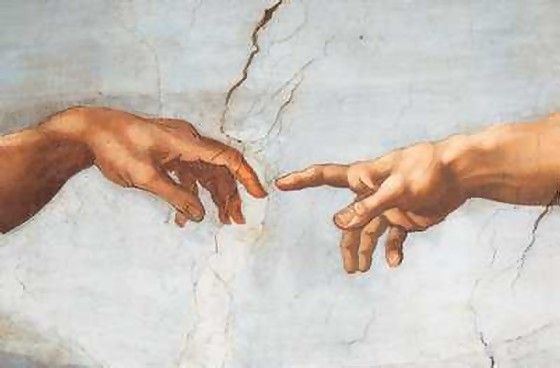
    hand of God